
News summary:
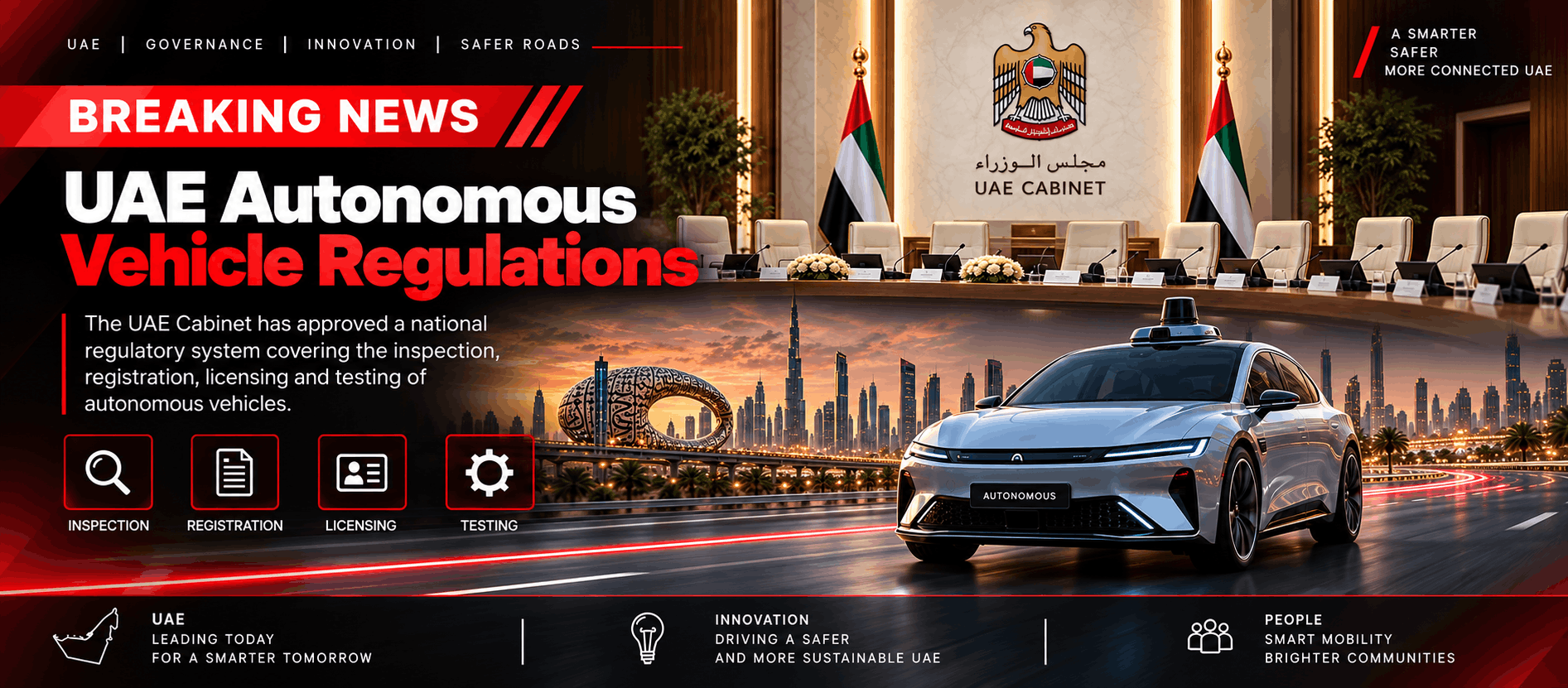
The UAE Cabinet has issued a resolution regulating self-driving vehicles and establishing a national framework for their inspection, registration, licensing and testing. The decision supports the country’s wider move towards smart and lower-emission transport.
The UAE Cabinet approved a resolution on 2 September 2026 establishing regulatory controls for the use of autonomous vehicles across the country.
The resolution introduces mechanisms for inspecting and registering self-driving vehicles, issuing and renewing their licenses, and testing new vehicle technologies before wider operation. The decision was announced following a Cabinet meeting chaired by Sheikh Mohammed bin Rashid Al Maktoum at Qasr Al Watan in Abu Dhabi.
What do the new rules cover?
According to the official announcement, the national system will address four principal areas:
-
Vehicle registration
-
Licensing and license renewal
-
Operational procedures for testing emerging vehicle technologies
Detailed technical standards, application procedures and implementation dates were not included in the Cabinet announcement. It is therefore not yet clear which categories of private or commercial autonomous vehicles will qualify first or what level of automation will be permitted under each operating license.
The resolution should not be interpreted as immediate permission for every self-driving vehicle to operate throughout the UAE. Testing zones, road conditions, safety requirements and responsibilities for operators are expected to depend on regulations and procedures issued by the relevant authorities.
Why is a national framework important?
Autonomous vehicles depend on more than cameras, sensors and artificial intelligence. Their operation also requires clear rules covering roadworthiness, software reliability, insurance, cybersecurity, accident responsibility and the way vehicles interact with conventional traffic.
A national system can help authorities apply consistent requirements when evaluating new technologies. It may also provide automotive manufacturers and mobility companies with a clearer route for conducting trials and introducing services.
The Cabinet said the resolution is intended to encourage alternative and environmentally friendly technologies while contributing to reduced road pollution and traffic congestion.
Many autonomous fleets use electric vehicles, although autonomous driving and electric propulsion are separate technologies. A vehicle can be electric without being autonomous, while automated-driving systems can also be installed in vehicles using other powertrains.
Dubai has already moved into commercial operations
The national decision follows several autonomous-mobility developments in Dubai.
Dubai’s Roads and Transport Authority began commercial autonomous-taxi services in Umm Suqeim and Jumeirah in March 2026, working with Apollo Go and WeRide. The first phase was planned to introduce 100 vehicles progressively into Dubai’s transport network.
RTA reported in August that its Robotaxi programmed had recorded more than four million kilometers and completed 7,613 passenger journeys. Its fleet included 144 vehicles, with 48 in active operation and approximately 50 journeys being completed each day. These figures were supplied by RTA and represent the authority’s reported operational results.
Dubai’s broader strategy aims to make 25% of transportation journeys smart and driverless by 2030. RTA nevertheless acknowledges that safety, legislation and technological capability remain important challenges for autonomous transport, particularly under local weather and traffic conditions.
What happens next?
The next significant development will be the publication of detailed implementation requirements. Motorists and transport companies should look for official information. Explaining eligible vehicle categories, inspection standards, licensing authorities, approved testing areas and the resolution’s effective date.
Until those details are released, existing traffic, vehicle-registration and licensing requirements remain applicable. Drivers must also continue to follow the operational restrictions governing any authorized autonomous transport service.
SOURCES
- Emirates News Agency — UAE Cabinet meeting — confirmation and scope of the autonomous-vehicle resolution.
- Dubai Roads and Transport Authority — Self-Driving Transport — Dubai’s autonomous-transport strategy and identified challenges.
- Dubai Media Office — Autonomous taxi operations — commercial rollout details.
- Dubai RTA — Robotaxi operational update — fleet, distance and passenger-trip figures.