
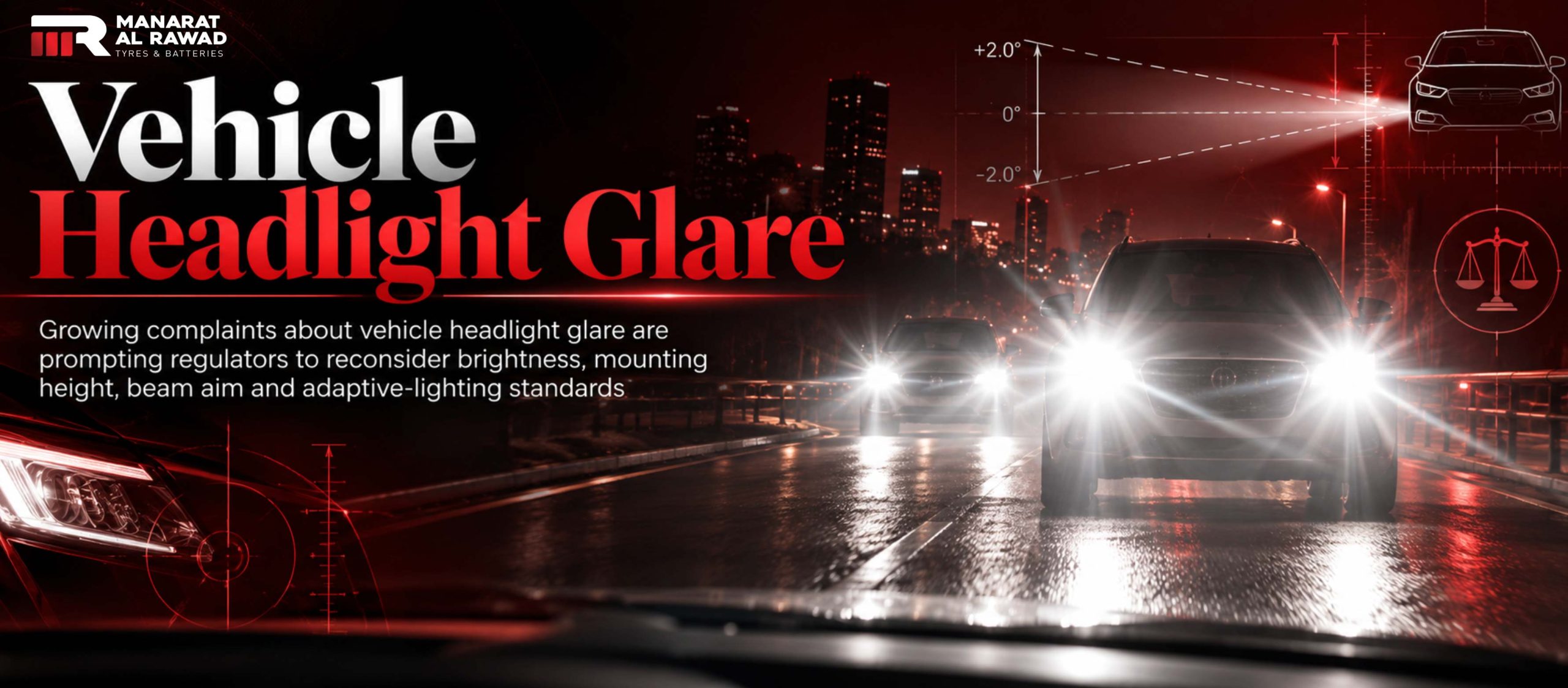
The United States National Highway Traffic Safety Administration has announced plans to modernize its vehicle-lighting regulations amid concerns about glare from modern headlights and restrictions affecting newer safety technology.
The review will cover LED headlights, automatic high beams, dusk sensors, replaceable light sources, headlamp mounting height and beam alignment. Regulators also intend to examine testing procedures and possible conformity with international vehicle-lighting standards.
Although the proposed changes concern American regulations, the issue is relevant internationally. Modern vehicles employing similar LED technology, tall SUV designs, and automated lighting systems are sold across the UAE and other global markets.
Why are regulators reviewing vehicle headlight glare?
Headlight technology has developed considerably, but some lighting regulations were written when halogen lamps were the industry standard.
LED headlights can provide brighter, more energy-efficient and more precisely controlled illumination. However, complaints can arise when the light source is mounted high, misaligned, or paired with an optical system that directs too much light toward other road users.
The growing number of SUVs and pickup trucks is also part of the discussion. Their headlights may be positioned higher than those on sedans and smaller cars, increasing the chance the beam reaches another driver’s mirrors or eye level.
NHTSA says its review will examine how headlamp height and aim affect both road visibility and glare. The agency will use a negotiated rulemaking process involving up to 18 representatives from safety groups, lighting manufacturers, research organizations, and engineering associations.
Are LED headlights automatically unsafe?
No. LED technology alone does not make a headlight unsafe.
A well-designed LED headlamp can provide clear road illumination while controlling the amount of light directed towards oncoming traffic. The result depends on the complete system, including:
- Headlamp lens and reflector design
- Beam pattern and cutoff
- Mounting height
- Vertical and horizontal alignment
- Automatic-leveling capability
- Vehicle load and suspension condition
- High-beam control software
Problems can arise when you install an LED bulb in a headlamp housing originally designed for a different light source. The reflector may scatter light instead of creating the intended beam pattern.
Even factory-installed headlights can produce discomfort if they are poorly aimed, mounted particularly high, or viewed while a vehicle is traveling over a rise or speed hump.
Is glare a major cause of nighttime crashes?
Glare is a genuine visibility and comfort issue, especially for older motorists and people with certain vision conditions. However, available crash data suggests that insufficient road illumination may contribute to more collisions than excessive headlight brightness.
Reuters cited an Insurance Institute for Highway Safety study covering 11 American states from 2015 to 2023. The study recorded vehicle headlight glare as a factor in about one or two of every 1,000 nighttime crashes. The research found that drivers aged over 70 appeared particularly affected by glare.
This does not mean glare should be ignored. Crash databases do not capture every situation in which temporary visual discomfort, slower reaction, or reduced contrast contributed to an incident.
The regulatory challenge is therefore to reduce unnecessary glare without decreasing the road illumination drivers need to identify pedestrians, animals, lane markings and other hazards.
What are adaptive driving beam headlights?
Adaptive driving beam headlights use cameras, sensors, and electronically controlled light elements to continuously change the beam pattern.
When the system detects an approaching vehicle, it can reduce or shade only the portion of the beam directed towards that vehicle. Other parts of the road can remain illuminated.
|
Lighting system
|
How it operates
|
| Conventional low beam | Uses a fixed pattern intended to limit glare |
| Conventional high beam | Provides greater range but must be manually dipped |
| Automatic high beam | Switches the entire high beam on or off |
| Adaptive driving beam | Adjusts individual sections of the light pattern |
The United States permitted adaptive driving beam technology in 2022, but manufacturers have argued that the country’s technical requirements have limited the adoption of systems already offered in other markets. The new review may make advanced lighting easier to deploy while continuing safety controls.
What does this mean for UAE drivers?
The American review does not automatically change UAE vehicle-lighting rules. Any regulatory change would apply within the United States unless UAE authorities separately enact similar requirements.
Nevertheless, the technology and safety discussion is relevant to the UAE because it combines high-speed roads, large SUVs, nighttime traffic, and seasonal fog.
Dubai’s RTA driving guidance advises motorists to dip high beams when another vehicle is visible, including when approaching from the opposite direction or following another vehicle.
Motorists should also avoid high beams in fog. Abu Dhabi Police explains that intense light can reflect off water droplets and reduce visibility rather than improve it. Low beams, reduced speed, and a greater following distance are safer in these conditions.
How can drivers reduce headlight problems?
Vehicle owners can take multiple practical steps:
- Check headlight alignment: Beam aim may change after accident repairs, suspension work, or repeated driving over rough surfaces.
- Avoid unsuitable bulb conversions: Don’t install high-output bulbs in housings not designed for them.
- Clean cloudy lenses: Oxidized or dirty lenses can scatter light and reduce useful road illumination.
- Use high beams responsibly: Dip them as soon as another road user comes into view.
- Do not retaliate: Flashing high beams at another driver can create additional glare and risk.
- Inspect automatic systems: Automatic high-beam assistance is helpful, but the driver remains responsible for intervening when necessary.
Drivers should also distinguish poor beam performance from an electrical fault. Dim or flashing lights, slow engine cranking, or dashboard warnings may indicate a battery, alternator, or wiring problem. In such cases, a mobile car battery testing service in the UAE can help determine whether the 12-volt battery is at fault, rather than assuming the headlight assembly has failed.
What happens next?
NHTSA is accepting comments and committee applications until November 9, 2026. The regulator will then work with industry and safety representatives to develop proposed revisions.
No final brightness limit or implementation date has been announced yet. Claims that the United States has already introduced a general ban on bright LED headlights would therefore be premature.
The eventual objective is not simply to make headlights dimmer. Regulators must balance two legitimate safety needs: letting drivers see far enough ahead while preventing that light from interfering with other road users’ vision.
Frequently Asked Questions
Why do SUV headlights sometimes appear brighter?
SUV headlights are generally mounted higher than those on smaller cars. Poor alignment or road angles can direct more light towards another driver’s mirrors and eyes.
Are LED headlights being banned?
No. The review intends to improve the rules governing LEDs and other lighting technologies, not ban them.
What is the difference between automatic high beams and adaptive headlights?
Automatic high beams switch the complete high-beam pattern on or off. Adaptive systems can selectively dim individual sections while keeping other areas illuminated.
Do the proposed rules apply in the UAE?
No. This is an American regulatory process. UAE requirements will remain separate unless local authorities introduce corresponding changes.
Should you use high beams in fog?
No. Reflected light can reduce visibility. Drivers should use low beams, reduce speed, and keep a safe distance.
Can a weak battery dim headlights?
Yes, but dim lights can also indicate alternator, wiring, bulb, or headlamp problems. Proper electrical testing is necessary to identify the cause.
SOURCES
- U.S. National Highway Traffic Safety Administration, vehicle-lighting standards announcement, October 6, 2026.
- Reuters, reporting on the American headlight-glare review and IIHS crash findings, October 6, 2026.
- Dubai Roads and Transport Authority, Light Motor Vehicle Handbook.
- Abu Dhabi Police, guidance for headlight use during fog.