
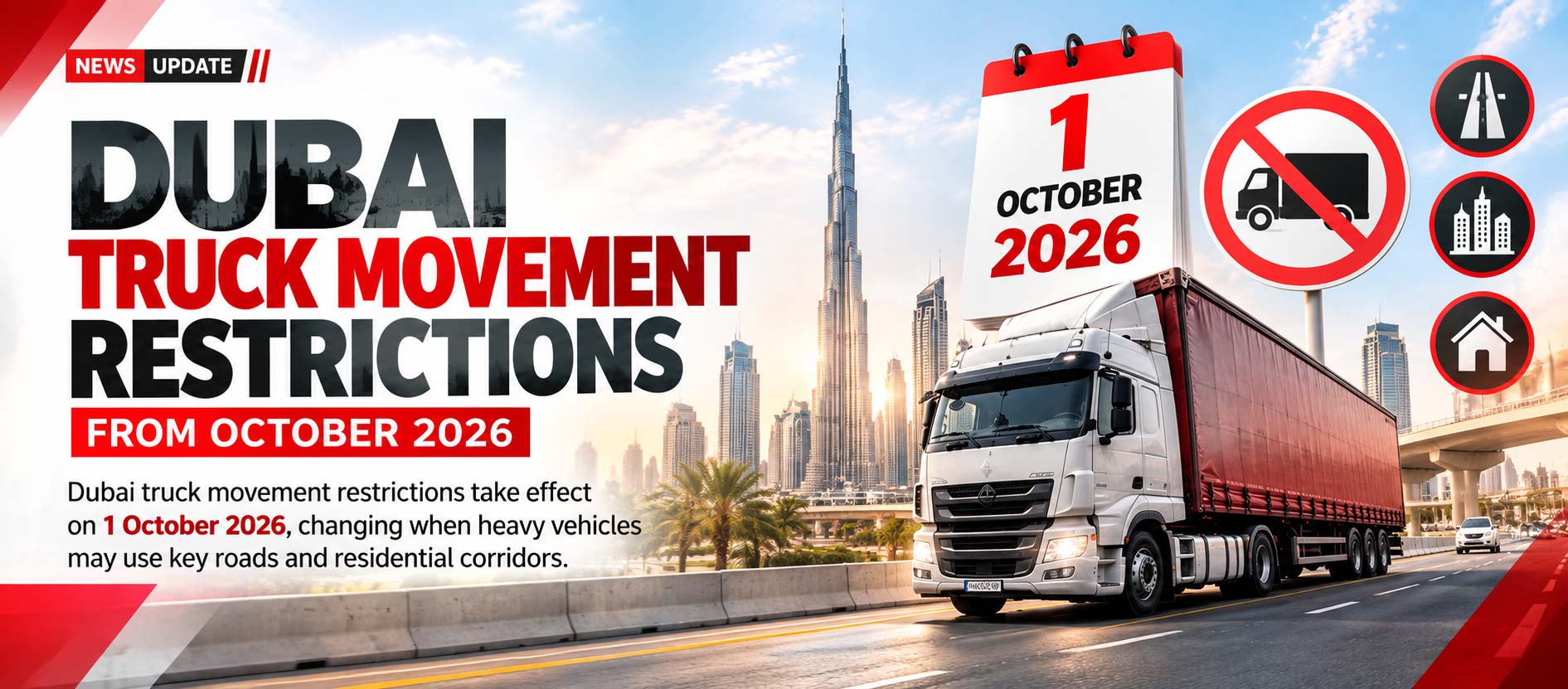
Dubai’s Roads and Transport Authority and Dubai Police have announced updated truck movement restrictions across the emirate, effective from 1 October 2026.
The measures regulate when heavy vehicles can use certain roads, tunnels, crossings and residential corridors. The applicable hours vary according to the location and expected congestion level, meaning the announcement is not a complete, round-the-clock ban on trucks across Dubai.
Emirates Road will remain exempt from the newly announced decision, making it an important alternative corridor for eligible heavy-vehicle journeys.
The authorities say the restrictions are intended to improve traffic flow, strengthen road safety and support the reliable movement of goods through Dubai’s expanding road and logistics network.
When do the Dubai truck movement restrictions apply?
RTA has divided affected locations into three main restriction categories.
| Road or location category | Restriction period |
| Al Qudra Street, Al Meydan Street, all crossings and Airport Tunnel | 24 hours |
| Sheikh Zayed Road, Beirut Street, Al Mizhar, Muhaisnah and Oud Al Muteena | 6:00 am to 10:00 pm |
| Airport Street, Oman Street and Damascus Street | Three daily peak periods |
| Emirates Road | Exempt from the announced decision |
On Airport Street, Oman Street and Damascus Street, truck movements are restricted during these three periods:
- 6:30 am to 8:30 am
- 1:00 pm to 3:00 pm
- 5:30 pm to 8:00 pm
These timings are particularly important for companies arranging deliveries, construction materials, warehouse transfers and journeys between industrial areas.
Operators should not assume that one restriction schedule applies to every Dubai road. The rules vary by corridor, area and traffic conditions.
Are private cars affected by the restrictions?
The announcement concerns trucks and heavy vehicles. It does not introduce movement restrictions for private cars, motorcycles or ordinary light passenger vehicles.
Private motorists may nevertheless notice changes in traffic patterns. Reducing truck movements on busy roads during peak periods could improve lane capacity and reduce interactions between heavy vehicles and smaller road users.
Some freight traffic may also move to permitted alternative corridors before or after restricted hours. Drivers should therefore remain alert around industrial areas, logistics districts and roads connecting to Emirates Road.
Why is Emirates Road exempt?
Emirates Road is a major route connecting Dubai with neighbouring emirates and important logistics areas. Its exemption allows commercial traffic to continue moving without requiring every truck to enter central or residential corridors.
However, the exemption does not mean drivers can use any connecting road at any time. Trucks will also be permitted on Emirates Road only through authorized routes as per restrictions on neighboring streets.
Fleet dispatchers should check the complete journey rather than considering only its main highway. A route may include an exempt road but still pass through an affected tunnel, crossing or urban corridor.
What should truck drivers do during restricted periods?
RTA has advised truck drivers and transport companies to plan routes in advance, follow directional signs and use permitted alternative roads.
Drivers who cannot continue their journey should use designated truck rest stops instead of parking randomly on main roads, residential streets or undesignated land.
Dubai has completed 14 of 16 planned truck rest stops across six strategic locations. Capacity at seven existing facilities has been expanded by 364 spaces, bringing the total number of parking spaces at those locations to 1,007.
More than 150,000 trucks reportedly use the rest facilities each month, while approximately 400,000 truck journeys take place across Dubai every day. Available amenities include rest areas, accommodation, prayer rooms, restaurants, shops and fuel stations.
Can a company obtain permission to travel during restricted hours?
Companies requiring heavy-vehicle movement during banned hours may apply for a permit in essential cases.
RTA directs eligible operators to apply for the Mobility Permit for Heavy Vehicles in Banned Times and Roads through its Right-of-Way Department. Approval should not be assumed, as the permit is intended for operations where travel during restricted periods is necessary.
Businesses should complete the process before dispatching a vehicle. The official announcement does not create an automatic exemption simply because a delivery is commercially important or time-sensitive.
How should logistics companies prepare?
Fleet and logistics operators can take several practical steps before the restrictions begin:
Review every regular route
Companies should identify journeys that use Sheikh Zayed Road, Beirut Street, Airport Street, Oman Street, Damascus Street or affected residential areas.
Update delivery schedules
Where possible, loading, dispatch and delivery times should be moved outside the applicable restriction periods.
Inform drivers clearly
Drivers should receive route-specific instructions rather than a general list of restricted roads. Navigation applications may not immediately reflect every heavy-vehicle rule.
Plan authorised waiting locations
Dispatchers should identify suitable truck rest stops before a driver begins the journey. This can prevent unsafe roadside parking and unnecessary searching during a restriction period.
Check vehicle readiness
Vehicles may remain parked for longer while waiting for an authorised travel window. Fleet managers should inspect tyres, cooling systems, fuel levels, alternators and batteries before departure.
Access to a dependable mobile battery service in Dubai can also help when a fleet or support vehicle develops a starting problem at a permitted stopping location. Battery testing, jump-start assistance and on-site replacement can reduce further delays, although operators must still follow access and parking regulations.
What do the restrictions mean for everyday Dubai traffic?
The immediate objective is to reduce the number of heavy vehicles using sensitive roads during the busiest periods.
The effect will depend on driver compliance, route planning and the capacity of alternative corridors.Transporting trucks outside of peak periods may help traffic flow on restricted roads, but could create busier periods around industrial zones and approved truck routes.
So the restrictions are part of a wider traffic-management system, not an end in itself.The effectiveness of the policy will be influenced by rest areas, permits, directional signs and enforcement.
Frequently Asked Questions
When do the restrictions start?
The announced Dubai truck movement restrictions take effect on 1 October 2026.
Are trucks completely banned from Dubai?
No. Restrictions vary by road and time. Some locations have full-day restrictions, while others restrict trucks only during specified hours.
Is Emirates Road restricted?
Emirates Road is exempt from the decision announced by RTA and Dubai Police.
Which roads have three daily restriction periods?
Airport Street, Oman Street and Damascus Street are restricted from 6:30 am to 8:30 am, 1:00 pm to 3:00 pm and 5:30 pm to 8:00 pm.
Where can trucks wait during restricted hours?
Drivers should use authorised truck rest stops and avoid parking on main roads, residential streets or undesignated areas.
SOURCES
- Dubai Roads and Transport Authority, “Truck Movement Restrictions during Peak Periods on Dubai Roads from 1 October 2026,” 26 September 2026.
- Government of Dubai Media Office, “RTA, Dubai Police Announce Truck Movement Restrictions on Roads Across Dubai from 1 October,” 26 September 2026.