
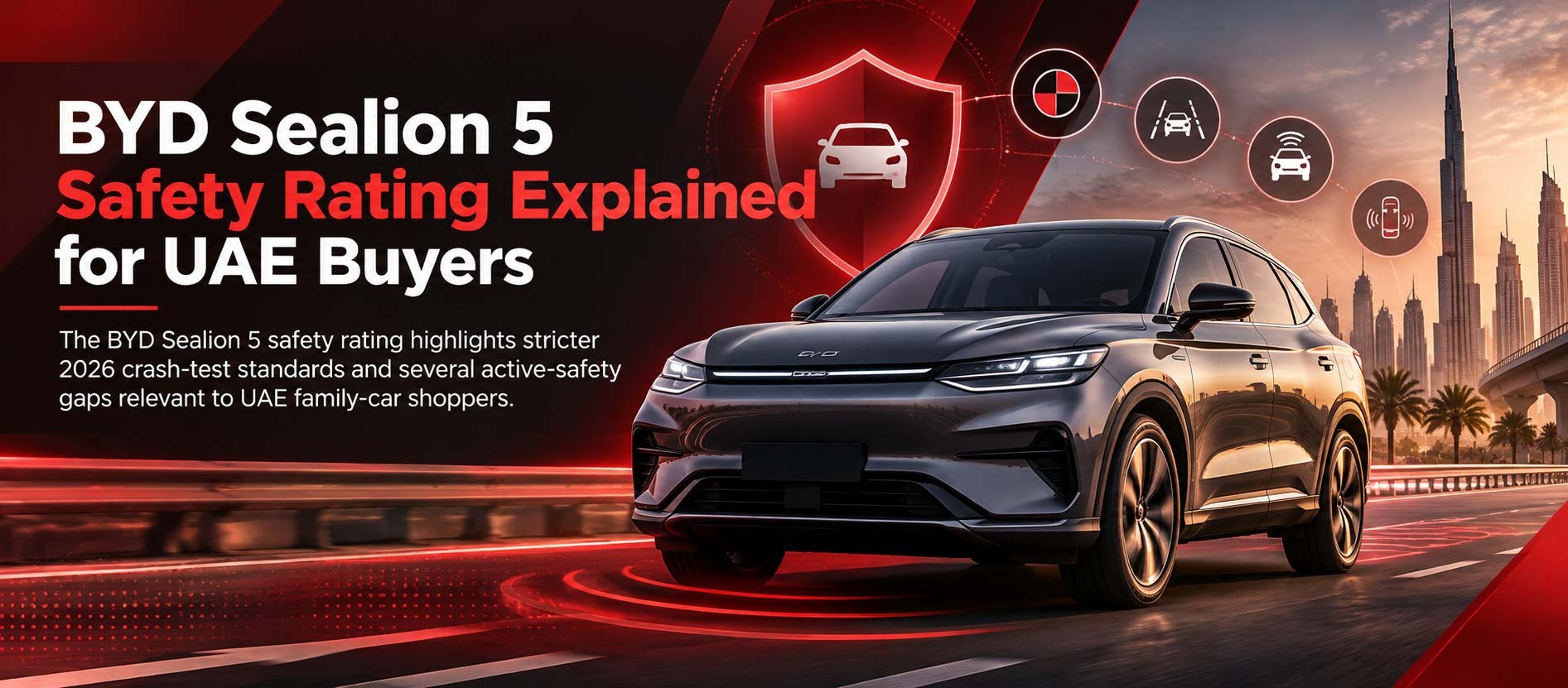
The BYD Sealion 5 plug-in hybrid SUV has received a three-star safety rating from the Australasian New Car Assessment Program, commonly known as ANCAP.
The result has attracted attention because BYD’s recent models have generally performed strongly in independent safety assessments. It is also significant because the Sealion 5 is the first vehicle evaluated under ANCAP’s substantially revised 2026 testing system.
The tested vehicle reportedly lost marks in areas including safe-driving assistance and crash avoidance. However, the result should not automatically be interpreted as meaning that the SUV failed every physical crash test or does not comply with legal vehicle standards.
For UAE consumers, an additional distinction is essential: the ANCAP result relates to the Australian-market specification tested by the organisation. Safety equipment fitted to UAE versions should be confirmed separately.
Why did the BYD Sealion 5 receive three stars?
Under the new testing system, ANCAP evaluates vehicles across four areas:
- Safe Driving
- Crash Avoidance
- Crash Protection
- Post-Crash Safety
A vehicle must reach minimum performance thresholds across the relevant categories to obtain the highest overall rating. Good results in one area cannot necessarily compensate for weaknesses elsewhere.
Reporting on the assessment indicates that the Sealion 5 performed below the five-star threshold in Safe Driving and Crash Avoidance. Its emergency lane-keeping system reportedly did not respond as required during one test scenario.
The assessed vehicle also lacked child-presence detection and an automatic emergency-call function. These omissions are increasingly important because modern safety ratings consider what happens before and after an accident, not only how well the passenger compartment performs during an impact.
What changed in ANCAP’s 2026 testing system?
From 2026, ANCAP reorganised its rating criteria around the complete sequence of a potential collision.
Safe Driving assesses technologies intended to support an alert and informed driver. These can include driver monitoring, speed assistance and systems that reduce distraction.
Crash Avoidance examines whether a vehicle can warn the driver or intervene when it detects another car, pedestrian, cyclist or potential road hazard.
Crash Protection covers traditional safety elements such as vehicle structure, airbags, seatbelts, head restraints and protection for vulnerable road users.
Post-Crash Safety considers emergency communication, rescue information and systems intended to help occupants during the critical period immediately after an accident.
The revised approach means a vehicle can offer acceptable structural protection yet still lose stars because of driver-monitoring, collision-avoidance or emergency-response limitations.
Does a three-star rating mean the Sealion 5 is unsafe?
Not necessarily. A three-star consumer rating and legal vehicle compliance are different measurements.
“You cannot sell a vehicle in a market without regulatory approval.The ANCAP rating rates vehicles against independent safety benchmarks that are generally above minimum legal requirements.
The three-star rating means the Australian version tested did not provide the balanced performance needed for four or five stars under the new protocol.Buyers should look at the reasons behind the score, not just the number.
It is also important not to compare a 2026 three-star rating directly with a rating issued many years earlier. Testing requirements become more demanding as safety technology develops.
Does the ANCAP result apply to the UAE Sealion 5?
The rating should not automatically be transferred to every Sealion 5 sold worldwide.
Vehicle specifications can differ between countries because of local regulations, trim levels, software versions and equipment packages. A safety function fitted as standard in one market may be unavailable, optional or configured differently in another.
The Sealion 5 is officially offered in the UAE as a five-seat plug-in hybrid SUV. BYD UAE states that it provides up to approximately 86 kilometres of electric-only WLTP range and a combined WLTP range of up to around 1,016 kilometres, depending on the variant.
UAE customers should ask the authorised dealer to confirm whether the local vehicle includes:
- Emergency lane-keeping assistance
- Autonomous emergency braking
- Driver-attention monitoring
- Child-presence detection
- Automatic emergency calling
- Front, side, curtain and centre airbags
- Multi-collision braking
- Regional software and navigation support
A feature appearing in international marketing material should not be assumed to be installed on every UAE trim.
What should buyers test during a showroom visit?
Safety systems should be considered alongside price, range, cabin space and fuel efficiency.
Buyers can ask the sales representative to demonstrate the driver-assistance menu and explain which systems activate automatically at startup. They should also check whether warning sensitivity can be adjusted and whether important functions remain active after the vehicle is restarted.
Families carrying young children should pay particular attention to ISOFIX locations, rear-seat reminders, child locks and child-presence detection. Emergency-call availability should also be confirmed because a system designed for another country may not necessarily connect to UAE emergency infrastructure.
The vehicle identification number and exact trim should be included when requesting specifications. This reduces the risk of comparing the local car with a differently equipped overseas model.
What does the result say about modern car safety?
The result shows that physical crash protection is no longer the only factor separating three-star and five-star vehicles.
Driver monitoring, lane intervention, pedestrian detection and post-crash communication now carry greater weight. As these systems become standard, independent testing organisations are raising the level of performance required from manufacturers.
This can make newer ratings appear harsher, but the objective is to encourage vehicles to prevent collisions as well as protect occupants when a collision cannot be avoided.
Is the hybrid battery included in the safety rating?
Battery protection forms part of the wider engineering and post-collision considerations for electrified vehicles, but the overall star rating covers much more than battery safety.
The Sealion 5 uses a high-voltage traction battery for electric propulsion and a separate low-voltage auxiliary battery for electronics and startup functions. Even when the traction battery has charge, a failed auxiliary battery may prevent a plug-in hybrid from entering its ready-to-drive mode.
Access to mobile car battery assistance in the UAE can therefore remain relevant for hybrid owners experiencing a low-voltage battery failure. Such assistance relates to the auxiliary battery and should not be confused with work on the high-voltage hybrid system, which requires appropriately trained technicians.
Frequently Asked Questions
What safety rating did the BYD Sealion 5 receive?
The Australian-market BYD Sealion 5 received a three-star ANCAP safety rating under the organisation’s new 2026 criteria.
Why was the rating limited to three stars?
Reported weaknesses included the performance of emergency lane-keeping assistance and the absence of child-presence detection and automatic emergency calling on the tested vehicle.
Is the UAE model identical to the tested vehicle?
That should not be assumed. Equipment and software can vary by market and trim, so buyers should verify the UAE specification with the authorised dealer.
Does the rating mean the car is illegal or unsafe to drive?
No. ANCAP is an independent consumer-rating programme, and its star requirements are different from minimum regulatory approval standards.
Should UAE buyers ignore an overseas safety rating?
No. It remains useful independent evidence, but it should be considered alongside the exact safety equipment installed on the UAE-market vehicle.
SOURCES
- ANCAP Safety, “Safety Before, During and After a Crash: New Generation Rating Approach From 2026.”
- News.com.au, reporting on the BYD Sealion 5’s three-star ANCAP assessment, 29 September 2026.
- ANCAP Safety, explanation of its vehicle star-rating methodology.
- BYD UAE and Al-Futtaim, official UAE Sealion 5 model information.