
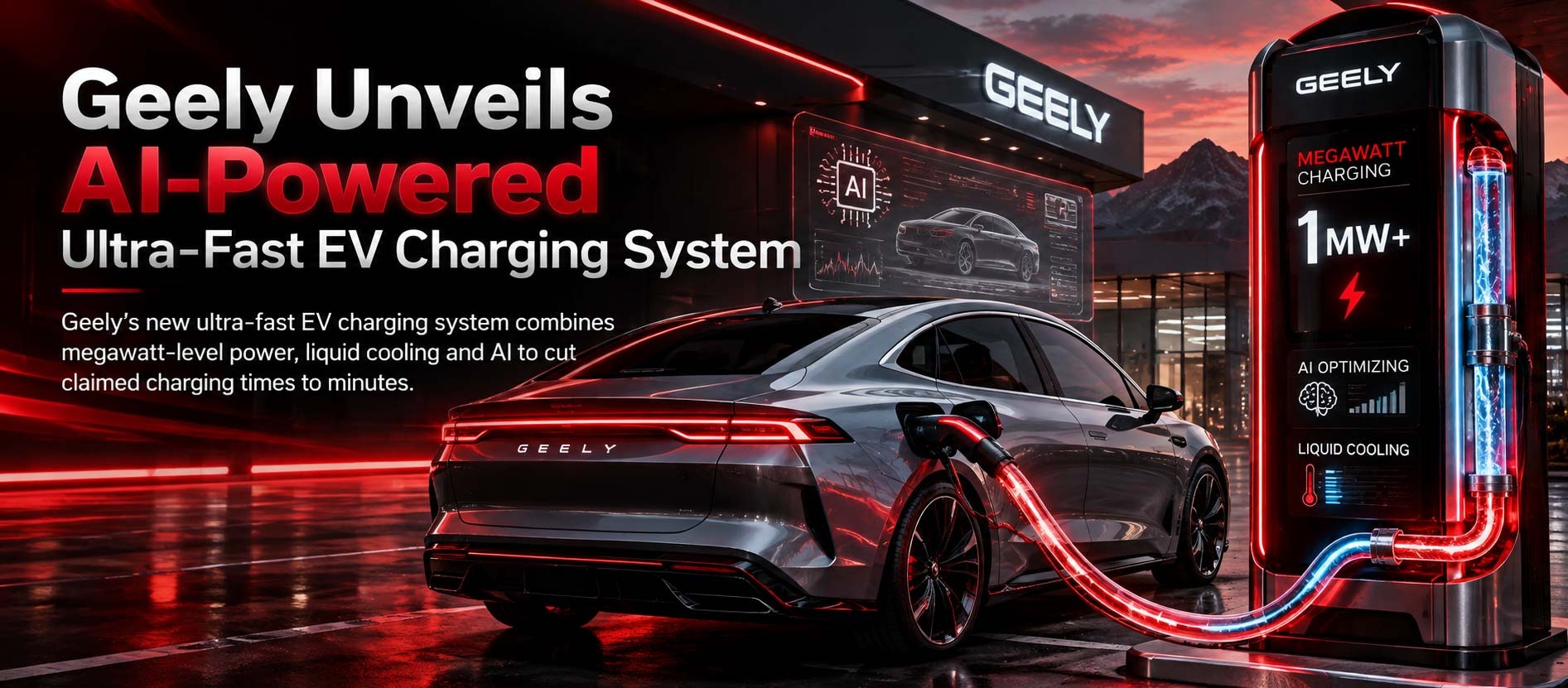
Chinese automotive group Geely has announced a new artificial intelligence-enabled charging system capable of raising a compatible electric vehicle battery from 10% to 70% in a claimed four and a half minutes.
The company also reports that the system can take the battery from 10% to 97% in eight minutes and 40 seconds under normal ambient conditions. Its charging hardware can reportedly deliver up to 2.25 megawatts through a single connector.
These figures place Geely alongside manufacturers including BYD in the intensifying competition to make EV charging times comparable with conventional fuel stops. However, the results apply to specialised batteries, vehicles and charging equipment—not every electric car currently on the road.
How fast is Geely’s new EV charging technology?
Geely’s stated charging results are:
| Charging measurement | Claimed result |
| Battery level from 10% to 70% | 4 minutes 30 seconds |
| Battery level from 10% to 97% | 8 minutes 40 seconds |
| Maximum output from one connector | Up to 2.25 MW |
The widely reported “four-minute charging” figure therefore does not describe a complete 0% to 100% recharge. It refers specifically to increasing the battery’s state of charge from 10% to 70%.
Charging normally slows as an EV battery approaches full capacity. This protects the cells from excessive heat and voltage, explaining why the final portion of a charging session can take disproportionately longer.
Geely’s results were also recorded under controlled conditions. Charging performance in daily use may vary according to battery temperature, starting charge level, vehicle model, charger capability and environmental conditions.
How does the ultra-fast EV charging system work?
Delivering more than two megawatts through one connector produces substantial heat. Geely says its system addresses this through a combination of high-rate battery cells, full-loop liquid cooling and AI-supported battery management.
The AI system reportedly monitors battery health and thermal behaviour while predicting temperature increases approximately 30 seconds in advance. The vehicle can then adjust cooling and power delivery before temperatures reach unsafe levels.
This predictive approach is important because charging speed is only one part of the engineering challenge. Manufacturers must also control cell degradation, maintain consistent performance and prevent overheating during repeated high-power sessions.
Geely has reportedly tested the technology with vehicles from its wider automotive group, including models associated with Zeekr and Lynk & Co. Commercial availability will still depend on compatible production vehicles and the rollout of suitable charging stations.
Can every electric vehicle use a 2.25 MW charger?
Nope. An EV must be designed to accept the charger’s voltage and power level.
Compatibility depends on several components:
- The traction battery’s cell chemistry and charging rate
- The vehicle’s electrical architecture
- Battery and cable cooling systems
- Connector and communication standards
- Charging software and safety controls
Connecting an existing EV to a more powerful station does not automatically make it charge faster. The vehicle controls how much power it accepts and will limit the charging rate to its supported maximum.
Charging sites also require sufficient electricity supply. A multi-bay station operating at megawatt-level output may need major grid connections, on-site energy storage or load-management systems to avoid excessive demand peaks.
Why does this matter to UAE drivers?
The UAE is expanding its public EV infrastructure quickly. DEWA said that Dubai had 47,944 electric vehicles by the end of 2025, with annual growth of 27.9%.By the beginning of 2026, the emirate also had more than 1,860 public and private charging stations.
National initiatives, including the UAEV charging network, are supporting broader coverage across the Emirates. The Ministry of Energy and Infrastructure has also identified transport electrification as part of the country’s energy and emissions strategy.
Geely has not confirmed a UAE launch timetable for this specific 2.25 MW system. Any local deployment would require compatible vehicles, certified charging equipment and infrastructure capable of handling the unusually high power demand.
The UAE climate presents an additional test. The headline charging figures were recorded under normal or room-temperature conditions. Extreme summer heat can increase cooling requirements and may cause a vehicle to reduce charging power to protect its battery.
Does ultra-fast charging damage an EV battery?
Frequent high-power charging can generate more heat and may accelerate battery wear if it is not carefully managed. Modern EVs use battery-management software and thermal systems to limit charging power when conditions are unsuitable.
Geely’s AI-based temperature prediction is intended to reduce this risk, but independent, long-term data will be needed to establish how the new system affects battery health after years of regular use.
Drivers should also distinguish an EV’s high-voltage traction battery from its conventional 12-volt auxiliary battery. The new charging technology applies to the traction battery. Services provided for ordinary car-battery testing, replacement or jump-starting address the separate 12-volt system found in electric, hybrid and petrol vehicles.
What happens next?
The most important development will be whether Geely can deploy the technology at scale rather than only demonstrate peak charging performance.
Industry observers will be watching for compatible production models, station rollout plans, third-party charging tests and results from hot-weather markets such as the UAE.
If those tests support Geely’s claims, ultra-fast EV charging could significantly reduce one of the main practical differences between electric vehicles and petrol-powered cars. Until then, the four-and-a-half-minute result should be understood as a technology benchmark achieved with a specific battery, vehicle and high-output charging system.
Frequently Asked Questions
Is Geely’s new charger available in the UAE?
No UAE deployment has been confirmed as of publication.
Does the battery charge completely in four and a half minutes?
No. Geely’s claim covers charging from 10% to 70%. Reaching 97% reportedly takes eight minutes and 40 seconds.
Can existing Geely EVs use the full 2.25 MW output?
Only vehicles specifically engineered for the required power, battery chemistry and cooling capability can use the system’s maximum output.
Will UAE heat affect charging speed?
Potentially. High ambient temperatures can increase cooling demands and cause an EV’s battery-management system to limit charging power.
SOURCES
- Reuters, reporting on Geely’s AI-enabled charging announcement, 23 September 2026.
- Reuters, technical explainer on charging output, cooling and battery protection, 24 September 2026.
- Associated Press, coverage of Geely’s charging claims and infrastructure challenges.
- Dubai Electricity and Water Authority, Dubai EV and charging-network statistics, 2026.
- UAE Ministry of Energy and Infrastructure, national electric-mobility and UAEV information.