
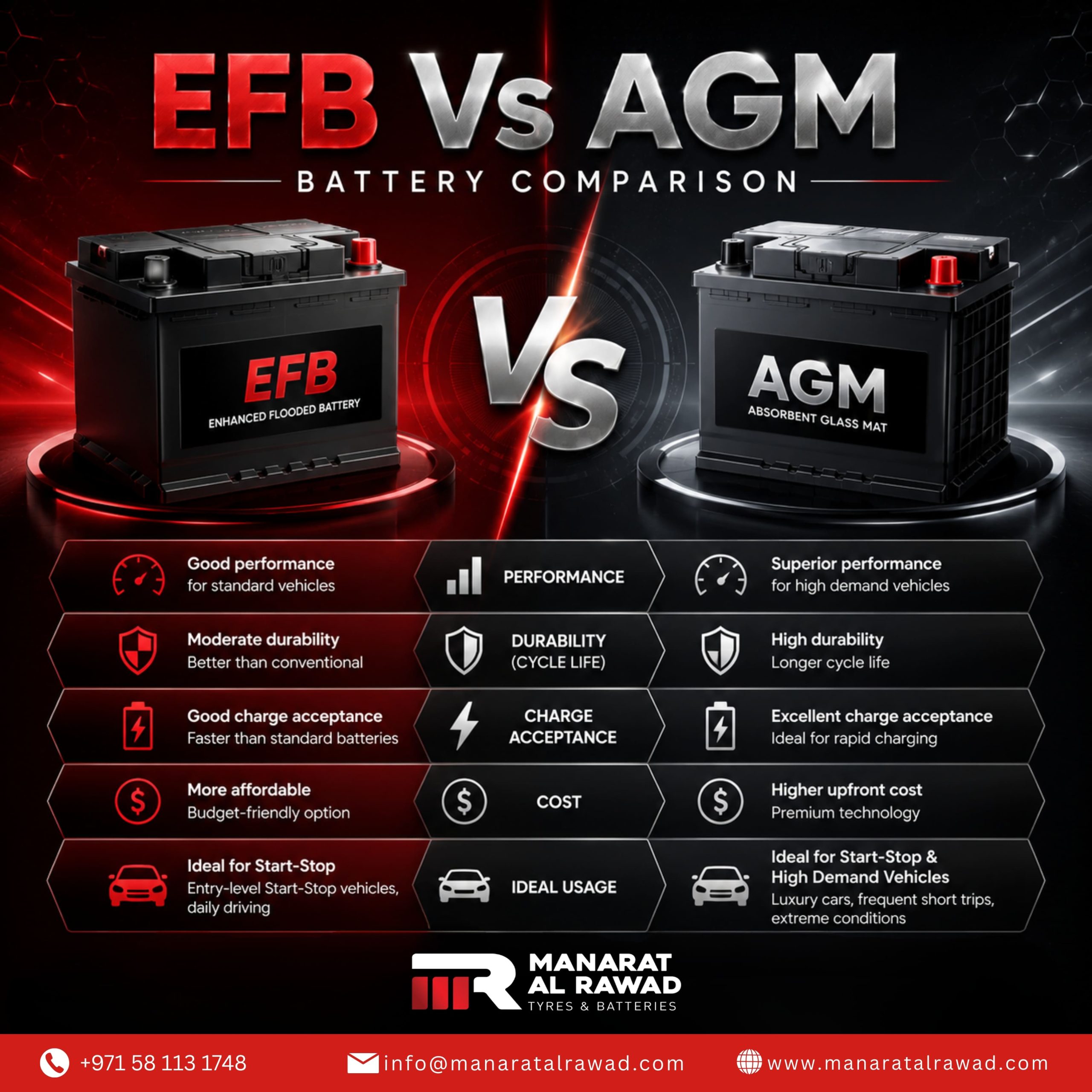
Choosing the right car battery is essential for your vehicle’s performance, reliability, and long-term maintenance costs. If you’ve been researching modern automotive batteries, you’ve likely come across the comparison EFB vs AGM battery. While both battery types are designed to deliver improved performance over conventional flooded batteries, they serve different purposes and use different technologies.
Many drivers assume EFB (Enhanced Flooded Battery) and AGM (Absorbent Glass Mat) batteries are interchangeable. In reality, each has individual advantages, limitations, and ideal applications. Selecting the wrong battery can reduce performance, shorten battery life, and even affect your vehicle’s electrical system.
This guide explains the differences between EFB and AGM batteries, compares their features, details their advantages and disadvantages, and helps you determine which option best suits your vehicle and driving habits.
What Is an EFB Battery?
An Enhanced Flooded Battery (EFB) is an upgraded version of a conventional flooded lead-acid battery. It is specifically designed to deliver improved durability, faster recharge capability, and better performance in vehicles equipped with basic start-stop systems.
Compared to standard flooded batteries, EFB batteries feature:
- Reinforced internal plates
- Improved electrolyte circulation
- Higher cycle resistance
- Better charge acceptance
- Longer service life
These improvements allow EFB batteries to handle frequent engine starts and repeated charging cycles more effectively than conventional batteries.
What Is an AGM Battery?
An Absorbent Glass Mat (AGM) battery is a more advanced lead-acid battery that uses fiberglass mats to absorb and hold the electrolyte, rather than allowing it to flow freely.
This sealed design affords several benefits:
- Spill-proof construction
- Faster charging
- Lower internal resistance
- Excellent vibration resistance
- Higher power output
- Longer cycle life
AGM batteries are commonly installed in premium vehicles, luxury cars, SUVs, and models installed with advanced start-stop systems or high electrical loads.
EFB vs AGM Battery Comparison
| Feature | EFB Battery | AGM Battery |
| Battery Technology | Enhanced Flooded Lead-Acid | Absorbent Glass Mat |
| Electrolyte | Liquid | Absorbed in glass mats |
| Maintenance | Low | Maintenance-free |
| Start-Stop Support | Basic systems | Advanced systems |
| Recharge Speed | Good | Excellent |
| Vibration Resistance | Good | Excellent |
| Deep Cycling | Moderate | Excellent |
| Lifespan | Longer than conventional batteries | Longest among lead-acid batteries |
| Cost | More affordable | Higher initial cost |
Are EFB and AGM Batteries Interchangeable?
| Battery construction | Enhanced flooded lead-acid | Absorbent Glass Mat |
| Charge acceptance | Good | Generally higher |
| High-frequency start/stop use | Designed for moderate start-stop | Better suited to demanding start-stop systems |
| Charging control | Conventional/start-stop compatible | Requires charging strategy compatible with AGM |
| Overcharging tolerance | Limited | Sensitive to incorrect charging voltage |
| Typical use | Vehicles with basic start-stop systems | Vehicles with advanced start-stop and higher electrical loads |
How this affects interchangeability
Important point
What Is the Difference Between EFB and AGM Batteries?
The primary difference rests in their internal construction and performance.
EFB Batteries
EFB batteries contain a liquid electrolyte, similar to traditional flooded batteries, but use reinforced plates and improved materials to increase durability.
They are suitable for:
- Vehicles with entry-level start-stop technology
- Daily commuting
- Moderate electrical demands
AGM Batteries
AGM batteries use fiberglass separators that hold the electrolyte securely.
This design provides:
- Faster charging
- Better resistance to vibration
- Greater energy output
- Improved performance under heavy electrical loads
AGM batteries are ideal for vehicles provided with advanced electronic features and premium accessories.
Advantages of EFB Batteries
EFB batteries provide several benefits over conventional flooded batteries.
Advantages
- Lower purchase cost than AGM batteries
- Improved durability
- Better charge acceptance
- Suitable for start-stop vehicles
- Longer lifespan than standard flooded batteries
- Reliable everyday performance
Limitations
- Lower deep-cycle capability than AGM
- Less resistant to vibration
- Lower power output
- Not recommended for vehicles requiring AGM technology
Advantages of AGM Batteries
AGM batteries are designed for demanding driving conditions and modern vehicle technology.
Advantages
- Excellent starting power
- Faster recharge rates
- Maintenance-free design
- High vibration resistance
- Superior deep-cycle performance
- Longer service life
- Ideal for premium vehicles
Limitations
- Higher purchase price
- Requires compatible charging systems
- May be unnecessary for vehicles with basic electrical systems
Pros and Cons Comparison
| Feature | EFB Battery | AGM Battery |
| Initial Cost | ✅ Lower | ❌ Higher |
| Lifespan | Good | Excellent |
| Recharge Performance | Good | Excellent |
| High Electrical Loads | Moderate | Excellent |
| Heat Resistance | Good | Very Good |
| Vibration Protection | Moderate | Excellent |
| Daily City Driving | Excellent | Excellent |
| Luxury Vehicles | Limited | Recommended |
Which Battery Lasts Longer?
When comparing EFB vs AGM battery, AGM batteries generally offer the longer lifespan.
Approximate service life:
- Conventional Battery: 2–3 years
- EFB Battery: 3–5 years
- AGM Battery: 4–6 years
Actual lifespan depends on:
- Climate
- Driving habits
- Vehicle charging system
- Maintenance
- Electrical demand
In the UAE, high temperatures may reduce battery lifespan regardless of battery type.
Which Battery Performs Better in UAE Heat?
Extreme heat is one of the biggest challenges for automotive batteries in the UAE.
Both EFB and AGM batteries are designed to outperform conventional flooded batteries, but AGM batteries generally offer greater resistance to vibration, repeated charging cycles, and heavy electrical loads.
However, no battery is immune to extended exposure to extreme temperatures. Parking in shaded areas, scheduling regular battery inspections, and replacing aging batteries before summer can greatly improve reliability.
Can You Replace an EFB Battery with an AGM Battery?
One of the most frequently asked questions when comparing EFB vs AGM battery is whether an EFB battery can be replaced with an AGM battery.
The answer is yes—but only if your vehicle manufacturer approves it.
Many modern vehicles with basic start-stop systems can be upgraded from an EFB battery to an AGM battery because AGM technology provides:
- Higher charging efficiency
- Better cycle life
- Improved performance under heavy electrical loads
- Greater resistance to vibration
- Longer service life
However, after installing an AGM battery, some vehicles require the Battery Control System (BMS) or Engine Control Unit (ECU) to be reprogrammed or registered. Without this step, the charging system may not charge the new battery correctly, which can shorten its lifespan.
Important: If your vehicle was originally equipped with an AGM battery, it is generally not recommended to downgrade to an EFB battery unless the manufacturer specifically allows it. Doing so may reduce performance and affect the start-stop system’s operation.
Which Battery Is Better for Start-Stop Vehicles?
Both battery types support start-stop technology, but they are designed for different levels of demand.
EFB Battery
Best suited for:
- Entry-level start-stop systems
- Daily commuting
- Standard passenger vehicles
- Moderate electrical loads
AGM Battery
Recommended for:
- Advanced start-stop systems
- Luxury vehicles
- SUVs
- Hybrid support systems
- Vehicles with multiple electronic accessories
- Cars with regenerative braking technology
If your vehicle has heated seats, premium infotainment, multiple cameras, electronic parking brakes, or numerous driver assistance systems, AGM is usually the preferred choice.
EFB vs AGM Battery Cost Comparison
Cost is often an important consideration when choosing a replacement battery. Although prices vary depending on the brand, capacity, and warranty, the general comparison is:
| Battery Type | Initial Cost | Long-Term Value |
| Conventional Flooded | Lowest | Moderate |
| EFB | Medium | Good |
| AGM | Highest | Excellent |
While AGM batteries require a higher initial investment, they often deliver greater value over time through:
- Longer lifespan
- Improved durability
- Better charging performance
- Reduced maintenance
- Increased reliability
For many drivers, especially those covering high annual mileage, the greater upfront cost can be offset by fewer replacements over the life of the vehicle.
Which Battery Is Best for Your Driving Style?
Choosing between an EFB and AGM battery depends on how and where you drive.
| Driving Scenario | Recommended Battery |
| Daily city commuting | EFB |
| Frequent stop-and-go traffic | AGM |
| Long-distance highway driving | AGM |
| Luxury vehicles | AGM |
| Family sedan | EFB or AGM (manufacturer dependent) |
| Commercial vehicle | AGM |
| Vehicles with high electrical demand | AGM |
Choosing a battery that meets your vehicle’s requirements helps maximize performance and battery life.
Does an AGM Battery Charge Faster Than an EFB Battery?
Yes.
AGM batteries typically accept charge more quickly due to their lower internal resistance and advanced construction.
Benefits include:
- Faster recovery after engine start
- Better performance during short journeys
- Improved efficiency during stop-and-go traffic
- Reduced charging losses
This makes AGM batteries particularly suitable for urban driving where vehicles are started and stopped frequently.
Battery Maintenance Tips
Regardless of which battery you choose, proper maintenance is essential.
Inspect the Battery Regularly
Look for:
- Corrosion around the terminals
- Loose connections
- Cracked or swollen casing
- Signs of leakage
Keep the Battery Clean
Dust and corrosion can reduce electrical conductivity. Cleaning the battery terminals periodically supports maintaining reliable performance.
Drive the Vehicle Regularly
Vehicles left unused for extended periods may experience battery discharge. Regular driving allows the alternator to recharge the battery.
Avoid Excessive Electrical Loads
Using lights, audio systems, or accessories while the engine is off can shorten battery life.
Schedule Professional Battery Testing
Testing the battery every six months helps detect declining performance before it leads to an unexpected breakdown.
Why Professional Battery Selection Matters
Choosing the wrong battery can lead to:
- Reduced battery lifespan
- Poor charging performance
- Start-stop system malfunctions
- Increased fuel consumption
- Warning lights on the dashboard
Professional technicians consider:
- Manufacturer specifications
- Battery size
- Cold Cranking Amps (CCA)
- Amp-hour (Ah) rating
- Battery technology
- Vehicle electronics
- Driving conditions
Selecting the correct battery provides reliable operation and protects your vehicle’s electrical system.
Why Choose Manarat Al Rawad?
At Manarat Al Rawad, we know that every vehicle has unique battery requirements. Our experienced technicians provide expert battery testing, diagnostics, and mobile car battery replacement services across Dubai and the UAE.
Our services include:
- Professional battery condition checks
- Genuine EFB and AGM batteries
- Mobile battery replacement
- Alternator and charging system inspection
- Start-stop battery diagnostics
- Battery registration guidance (where applicable)
- Warranty-backed battery installation
- 24/7 roadside assistance
We recommend batteries based on your vehicle’s specifications—not just price—so you receive the best combination of performance, safety, and long-term value.
Frequently Asked Questions
Which lasts longer, EFB or AGM?
AGM batteries generally last longer because they are designed for higher cycle life and improved durability.
Can I upgrade from EFB to AGM?
In many vehicles, yes. However, always check your manufacturer’s recommendations, as some vehicles require battery registration or charging system updates after installation.
Is an AGM battery worth the extra cost?
If your vehicle has advanced electronics, a start-stop system, or high electrical demand, an AGM battery often provides better long-term value despite the higher purchase price.
Which battery performs better in hot weather?
Both EFB and AGM batteries are built to handle tough conditions better than conventional batteries. Proper maintenance and periodic inspections remain essential in the UAE’s extreme climate.
Does an AGM battery require maintenance?
No. AGM batteries are sealed, maintenance-free batteries that do not require water top-ups.
Final Verdict: EFB vs AGM Battery
When comparing EFB vs AGM battery, there is no single “best” choice for every vehicle. The right battery depends on your vehicle’s design, electrical requirements, and driving habits.
An EFB battery is an excellent option for drivers with basic start-stop systems who want improved performance at a moderate cost. It offers greater durability than a conventional flooded battery and is well-suited to routine commuting.
An AGM battery, on the other hand, is the premium answer for modern vehicles provided with advanced electronics, luxury features, or high electrical demands. It delivers faster charging, superior deep-cycle performance, and a longer service life, rendering it a worthwhile investment for many drivers.
Before replacing your battery, always consult your vehicle manufacturer’s recommendations or seek advice from a qualified technician. Choosing the correct battery not only improves reliability but also protects your vehicle’s electrical system and secures optimal performance in the UAE’s challenging climate.
At Manarat Al Rawad, we help drivers make well-informed battery choices through professional diagnostics, expert recommendations, and reliable mobile car battery replacement services. Whether your vehicle requires an EFB or AGM battery, our team stays devoted to providing dependable solutions that keep you moving with confidence.