
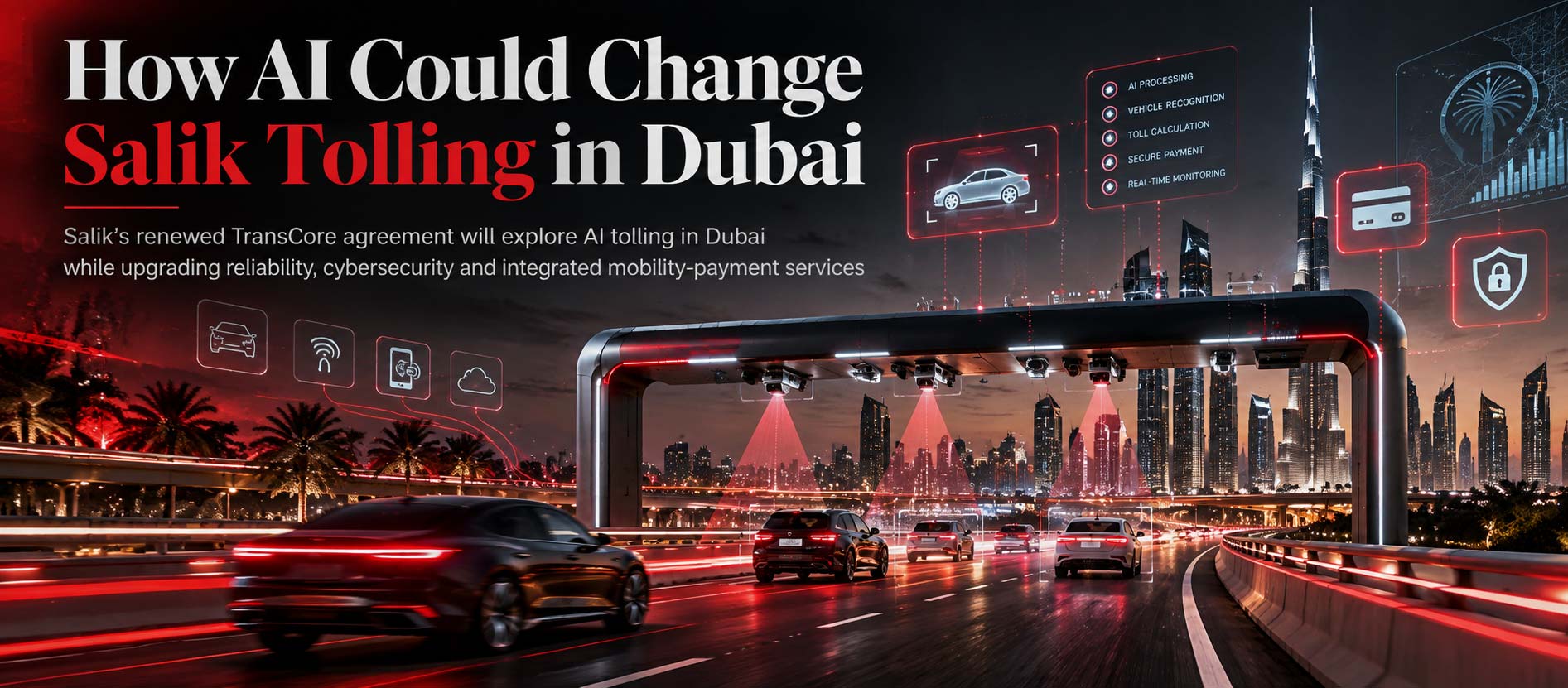
Salik Company has renewed its strategic technology partnership with US-based tolling specialist TransCore for another five years, extending a relationship that helped create Dubai’s original electronic road-toll system.
The renewed agreement covers the continued development of technology supporting toll operations. It also allows the two companies to explore artificial intelligence and other advanced digital solutions intended to improve efficiency, reliability and readiness for Dubai’s future mobility requirements.
For motorists, the announcement signals further development of the systems operating behind toll gates and connected payment services. However, it does not introduce a new toll gate, change an existing tariff or announce an immediate alteration to how drivers are charged.
What does the Salik and TransCore agreement cover?
TransCore has worked with Dubai’s tolling system since 2006, when the company contributed to the design and development of the original platform.
Under the renewed five-year agreement, the companies will continue developing the systems and infrastructure supporting toll collection. The contract also strengthens requirements related to:
- Cybersecurity
- System maintenance
- Business continuity
- Sustainability
- Governance
- Operational and regulatory compliance
Salik said the partnership would explore AI technologies and advanced digital solutions that could improve system performance and support the future expansion of Dubai’s smart-mobility ecosystem.
How does Salik’s automatic tolling technology work?
Salik operates as a barrier-free tolling system. Drivers do not need to stop at a physical booth or make a manual payment while passing beneath a toll gate.
It uses technologies such as Radio Frequency Identification and Automatic Number Plate Recognition.The vehicle’s Salik tag is read by an RFID reader. Number-plate recognition can help identify vehicles and process transactions.
When a registered vehicle passes through a chargeable gate, the applicable amount is deducted from the Salik account of the vehicle.The system lets traffic flow without toll booths, tickets or cash payments.
But the technology has to do a lot of things quickly. It has to identify the tag, match it to an account, authenticate the journey and record the transaction correctly.
How could artificial intelligence improve tolling?
The official statement does not specify which AI tools will be introduced.“Salik and TransCore will explore opportunities to deploy AI to improve operational efficiency and system performance,” it said.
Potential applications could include detecting unusual transactions, aiding number-plate recognition, detecting equipment faults and forecasting when technical maintenance might be required. These are reasonable industry use cases rather than confirmed features of the renewed contract.
AI could also help analyse traffic and transaction patterns, improve customer-service response times or identify cases requiring manual review. Any such deployment would need to comply with the agreement’s strengthened cybersecurity and governance requirements.
The objective is not necessarily to make toll gates more visible to drivers. Successful improvements may largely take place in background systems that process journeys, payments, account information and technical alerts.
Will the agreement change Salik toll prices?
No toll-price change was announced as part of the TransCore agreement.
The announcement concerns technology development and operational support. It should not be interpreted as confirmation of a new tariff, an additional toll gate or a new peak-period charge.
Any future changes affecting motorists would require a separate official announcement. Drivers should rely on Salik, RTA or Dubai Government communication channels rather than messages circulated through unofficial social-media accounts.
Is Salik becoming more than a toll-payment system?
Yes. Salik has been extending its payment platform into parking and other mobility services.
Its e-wallet has been integrated with private parking operations, while an agreement with Dubai Airports introduced Salik payments across 7,400 designated spaces at Dubai International Airport’s terminals and Cargo Mega Terminal.
Salik has also worked with Parkonic on parking-payment integration and with Valtrans to support digital valet-parking payments at participating locations across the UAE.
These developments indicate that a Salik account may increasingly function as a broader mobility-payment account rather than being used only when a vehicle crosses a toll gate.
The renewed TransCore partnership is intended to support this expansion by preparing the technical platform for existing services and possible future activities.
What new digital features could Salik users receive?
Salik’s 2025 annual report said its 2026 digital roadmap included new app services such as tag-health monitoring, parking notifications and account alerts.
The roadmap also referred to an AI-powered WhatsApp service offering self-service functions and multilingual support. Availability should be checked through official Salik channels because a planned feature should not be assumed to have launched for every customer.
Tag-health monitoring could be particularly useful because a damaged, incorrectly installed or unreadable tag may create account problems. Clearer alerts could help motorists identify an issue before it results in missed payments or repeated notifications.
What should سائقو المركبات do now?
Drivers do not need to replace a Salik tag or open a new account because of the partnership announcement.
They should continue to:
- Keep sufficient credit in their Salik account
- Confirm that the correct vehicle and number plate are registered
- Install the tag according to official instructions
- Check transaction and parking notifications
- Update contact details when they change
- Use official channels to investigate unfamiliar charges
Fleet operators should also regularly reconcile Salik transactions with vehicle schedules. Accurate records become increasingly important when one account manages several vehicles, parking payments and frequent toll journeys.
Does smarter road technology replace roadside preparation?
No. Digital tolling can make payments and journeys more efficient, but it cannot prevent mechanical or electrical breakdowns.
Dubai’s heat can place significant pressure on a vehicle’s conventional 12-volt battery, particularly when the car frequently powers connected electronics, tracking equipment and in-cabin systems.
Access to a reliable mobile car battery service in Dubai can remain useful when a vehicle does not start at home, in a car park or at a permitted roadside location. Drivers should stop safely and follow road-authority instructions before requesting assistance.
Why does cybersecurity matter for smart tolling?
An integrated mobility-payment platform processes vehicle identifiers, transaction histories and account information. As the platform connects more parking providers and mobility services, data protection is critical.
The renewed contract contains, in particular, stronger requirements on cybersecurity, governance and business continuity.These measures are designed to enable services to function reliably and to minimize the risks of system disruption or unauthorized access.
As AI tolling in Dubai develops, public trust will depend on accuracy, transparent communication and responsible handling of customer information—not only the speed of payment processing.
الأسئلة الشائعة
Has Salik announced new toll gates?
No new toll gate was announced as part of the TransCore partnership renewal.
Will Salik toll fees increase?
The technology agreement did not announce a change to toll tariffs.
How long will the renewed partnership last?
The renewed Salik and TransCore agreement runs for five years.
What technology does Salik use?
Salik’s tolling infrastructure uses technologies including RFID tags and automatic number-plate recognition to process barrier-free toll transactions.
Where else can a Salik account be used?
Salik has expanded into selected parking and valet-payment services, including parking integration at Dubai International Airport and participating private locations.
مصادر
- Government of Dubai Media Office, “Salik Renews Five-Year Partnership With TransCore for Tolling and Technology Development,” 6 September 2026.
- Salik Integrated Annual Report 2025, Digital Solutions and Operational Review.
- Government of Dubai Media Office, Dubai Airports and Salik e-wallet parking agreement.
- Government of Dubai Media Office, Salik and Valtrans digital valet-payment partnership.