
News Summary
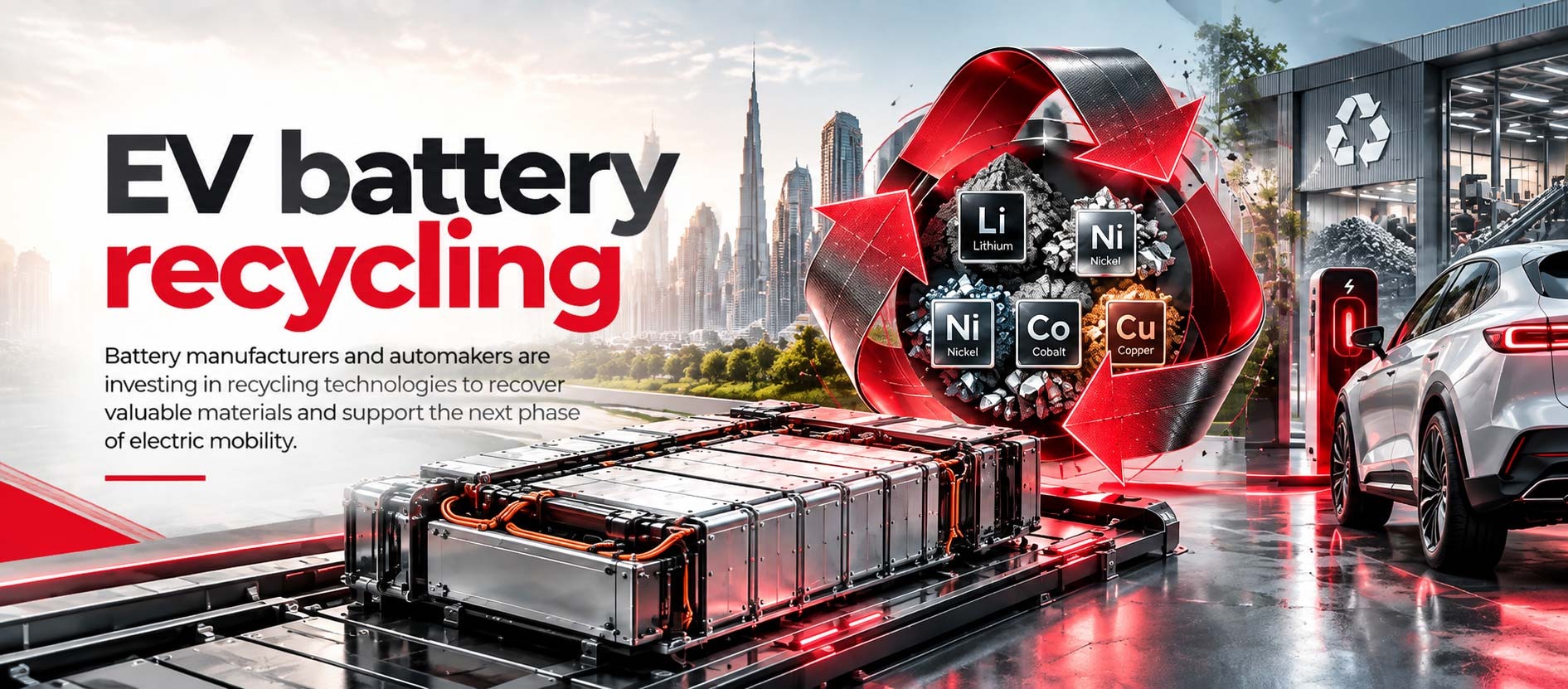
The global automotive industry is increasing investment in electric vehicle battery recycling as more EVs enter the market and manufacturers prepare for future battery volumes.
Battery recycling allows companies to recover valuable materials, reduce waste and support a more sustainable electric mobility ecosystem. The development is becoming increasingly relevant for markets such as the UAE, where electric vehicle adoption and charging infrastructure continue to expand.
What Is Driving the Growth of EV Battery Recycling?
Electric vehicles rely on lithium-ion battery packs that contain valuable materials such as lithium, nickel, cobalt, manganese and copper. As the number of electric vehicles increases globally, manufacturers are preparing for the future stage when large numbers of batteries will reach the end of their first vehicle life. Battery recycling helps recover materials that can potentially be used in new battery production. The process can reduce dependence on newly mined raw materials and support a more circular battery supply chain.
How Does EV Battery Recycling Work?
The battery recycling process generally involves several stages:
Battery Collection and Testing
When an EV battery is removed from a vehicle, specialists first evaluate its condition.
Some batteries may still have enough capacity for a second-life application, while others may require material recovery.
Battery Reuse and Second-Life Applications
A battery that is no longer suitable for vehicle use may still be useful for stationary energy storage.
Examples include:
- Renewable energy storage systems
- Commercial energy backup
- Building energy management systems
Material Recovery
Batteries that cannot be reused are processed to recover valuable materials.
Recovered materials can include:
- Lithium
- Nickel
- Cobalt
- Copper
- Aluminium
These materials can potentially return to the battery manufacturing supply chain.
Why Is Battery Recycling Important for Electric Vehicles?
Battery recycling addresses several challenges connected with EV growth.
Reducing Raw Material Pressure
Electric vehicle demand increases the need for battery materials. Recycling can provide an additional source of materials and reduce dependence on newly extracted resources.
Supporting Sustainable Manufacturing
Automotive manufacturers are increasingly focusing on reducing the environmental impact of vehicle production. Battery recycling is becoming one part of wider sustainability strategies covering manufacturing, supply chains and vehicle lifecycle management.
Improving Battery Lifecycle Management
A vehicle battery does not necessarily become unusable after it leaves a vehicle. Depending on its condition, it may continue serving in another application before final recycling.
What Does This Mean for UAE Electric Vehicle Owners?
The UAE has been expanding electric mobility through charging infrastructure development, government sustainability initiatives and increasing availability of EV models.
For UAE vehicle owners, future battery recycling developments could influence:
- Long-term EV ownership planning
- Battery replacement options
- Vehicle resale considerations
- Manufacturer sustainability programmed
- Future automotive service requirements
However, battery recycling infrastructure for passenger vehicles is still developing, and specific UAE recycling procedures may depend on manufacturers, regulators and specialized recycling companies.
Why Is Battery Recycling Relevant to Automotive Service Companies?
As vehicle technology changes, automotive service providers are expected to deal with new battery-related requirements.
Future services may involve:
- Battery health assessment
- EV battery diagnostics
- Battery lifecycle management
- Safe handling procedures
- Manufacturer-approved replacement processes
Traditional vehicle batteries and EV high-voltage battery systems require different handling methods. EV battery servicing involves specialised equipment, training and safety procedures.
Frequently Asked Questions
What happens to an EV battery after it stops working?
An EV battery may either be reused for another application if it still has sufficient capacity or processed through recycling systems to recover valuable materials.
Can EV batteries be recycled?
Yes. Modern battery recycling processes can recover materials such as lithium, nickel, cobalt and copper from used battery packs.
Why is EV battery recycling important?
Battery recycling helps reduce waste, recover valuable materials and support a more sustainable electric vehicle supply chain.
Will UAE drivers benefit from EV battery recycling?
As EV adoption grows in the UAE, improved battery lifecycle management could support future vehicle ownership, maintenance and sustainability programmes.
Are EV batteries replaced like normal car batteries?
No. Traditional 12-volt vehicle batteries and EV high-voltage battery packs are different systems. EV battery replacement requires specialised equipment and trained technicians.
UAE Relevance: The Future Battery Ecosystem
The UAE automotive market is gradually moving toward greater electric mobility adoption. As more electric vehicles enter the market, battery lifecycle management will become an important part of the automotive ecosystem. Future developments in recycling, battery technology and energy storage could influence how vehicles are manufactured, maintained and retired. For UAE motorists, understanding battery technology will become increasingly important as electric and hybrid vehicles become more common on roads.
What Happens Next?
The next phase of EV battery development will likely focus on improving recycling efficiency, reducing processing costs and creating stronger connections between battery manufacturers, automotive companies and recycling networks.
While lithium-ion batteries remain the dominant technology for electric vehicles today, improved recycling systems could help create a more sustainable battery supply chain for future mobility.
SOURCES
- International Energy Agency (IEA) — Global EV Outlook and battery lifecycle research
- International Renewable Energy Agency (IRENA) — Battery recycling and sustainable mobility studies
- CATL — Battery recycling and lifecycle management initiatives
- European Commission — Battery regulation and recycling framework