
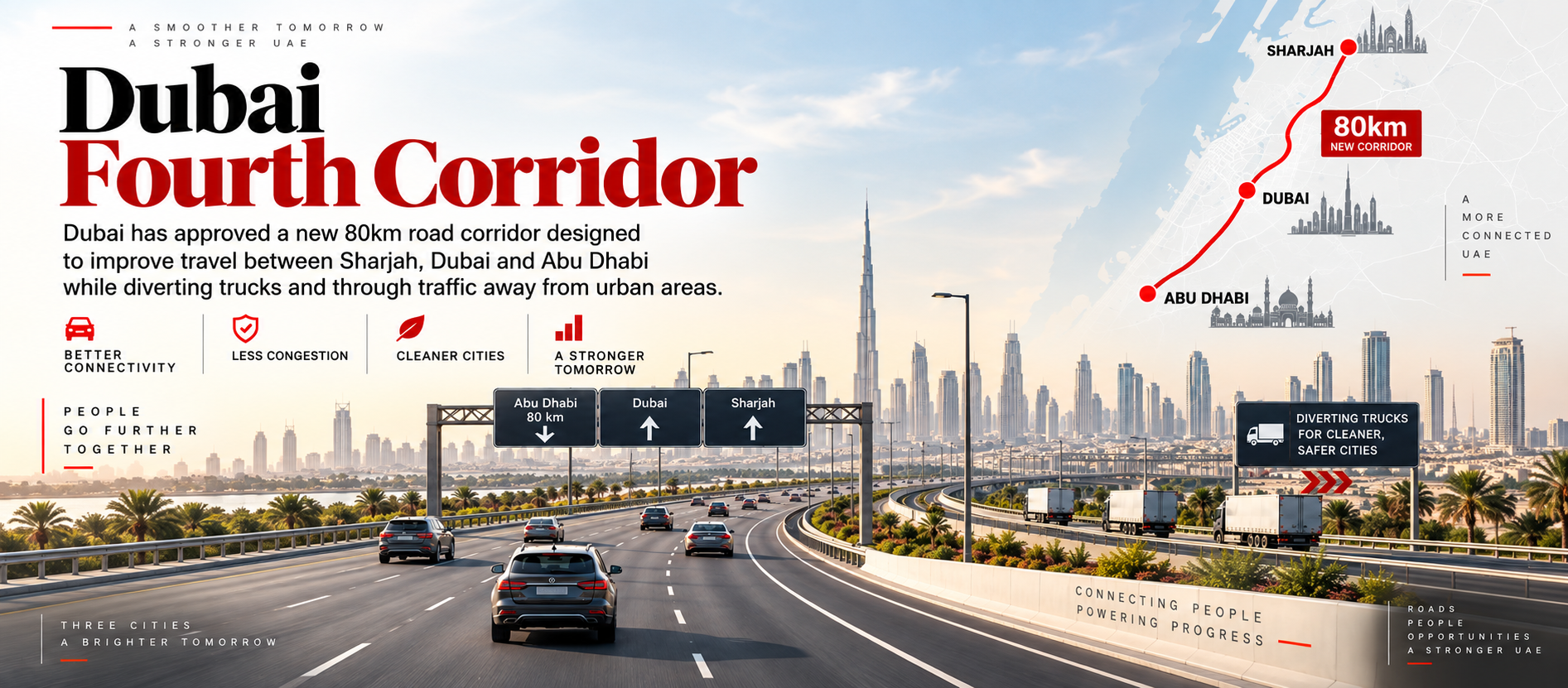
News summary: Dubai has approved an 80km Fourth Corridor extending from Al Shanouf Road in Sharjah to Al Faya Road in Abu Dhabi. The first phase will cost approximately AED3.5 billion and provide an alternative route for motorists and commercial vehicles travelling between the emirates.
Dubai has approved the implementation of a new 80km road corridor intended to strengthen connections between Sharjah, Dubai and Abu Dhabi.
The New Fourth Corridor will extend from Al Shanouf Road in Sharjah to Al Faya Road in Abu Dhabi. It will become the fourth major inter-emirate road corridor alongside Sheikh Zayed Road and Al Ittihad Road, Sheikh Mohammed bin Zayed Road and Emirates Road.
The project was approved by Sheikh Hamdan bin Mohammed bin Rashid Al Maktoum, Crown Prince of Dubai, Deputy Prime Minister, Minister of Defence and Chairman of the Executive Council of Dubai. It will be constructed in two phases, according to the Emirates News Agency.
What will the Fourth Corridor include?
The complete project will comprise:
- Approximately 80km of roadway
- 12 traffic lanes across both directions
- 72 bridges
- 17 tunnels
- 45 stormwater drainage culverts
- Capacity for as many as 24,000 vehicles per hour across both directions
The route will pass several important transport, residential and environmental locations, including Al Maktoum International Airport, the Etihad Rail route, Al Marmoom Desert Conservation Reserve and Al Wohoosh Desert Conservation Reserve.
It is also expected to improve access to areas including Madinat Latifa, Madinat Hind, Al Yalayis, Al Awir and Dubailand.
First phase to cost AED3.5 billion
The first phase will cover approximately 30km between Al Shanouf Road in Sharjah and Dubai–Al Ain Road. Estimated to cost AED3.5 billion, this section will have six lanes in each direction and capacity for up to 24,000 vehicles per hour across both directions. Dubai’s Roads and Transport Authority expects it to reduce journey time along the relevant route by 60%, from approximately 35 minutes to 14 minutes. Around 600,000 people are expected to benefit from the first phase.
Construction will include approximately 55 lane-kilometres of surface roads, 2.5km of tunnels and 21km of bridges and ramps. Dubai–Al Ain Road will also be widened from three to four lanes in each direction between Emirates Road and Lehbab Road. Four major intersections will be upgraded as part of the work.
Second phase will extend towards Abu Dhabi
The second phase will cover the remaining 50km between Dubai–Al Ain Road and Al Faya Road in Abu Dhabi. This section will also contain 12 lanes across both directions and provide capacity for approximately 24,000 vehicles per hour. Expected journey time on the route would fall by 52%, from around 50 minutes to 24 minutes. The authorities estimate that approximately 3.1 million people will be served by this phase.
It will include around 190 lane-kilometres of surface roads, 3.5km of tunnels and 157km of bridges and ramps. The announcement did not specify the cost of the second phase or provide construction and completion dates for either section.
How could the new road affect motorists?
The corridor is intended to provide another option for motorists travelling between the Northern Emirates, Dubai and Abu Dhabi. It could reduce pressure on established inter-emirate routes such as Emirates Road and Sheikh Mohammed bin Zayed Road, particularly during peak periods.
However, the predicted time savings apply to the completed project and specific sections of the route. Motorists should not expect an immediate reduction in current journey times because a construction schedule and opening date have not yet been announced.
Detailed junction locations, temporary traffic arrangements and individual access points are also expected to become clearer as the project enters its implementation stages.
Trucks could be diverted away from urban roads
A significant objective of the project is to redirect through traffic—particularly heavy vehicles—away from densely populated urban areas.
This could improve traffic flow and road safety while providing logistics and commercial-transport operators with a more direct route between industrial areas, airports, rail infrastructure and other emirates.
The corridor’s connection with Al Maktoum International Airport and Etihad Rail is also intended to support integration between road, aviation and railway networks. RTA Director General Mattar Al Tayer said the project would ease pressure on existing road corridors while supporting Dubai’s urban growth and strengthening connectivity between the emirates.
And then?
The project has received implementation approval, but the authorities have not announced when construction will begin or when the two phases will open. Further updates are expected to cover construction contracts, completion targets, junction designs and temporary road changes. Until new sections officially open, motorists should continue using existing inter-emirate routes and follow traffic announcements issued by RTA and other relevant authorities.
SOURCES
- Emirates News Agency — Fourth Corridor approval — official route, phases, capacity, infrastructure and journey-time figures.
- The National — Dubai approves 12-lane motorway — affected communities and wider transport context.
- Gulf News — Dubai approves 80km Fourth Corridor — project overview and inter-emirate logistics significance.