
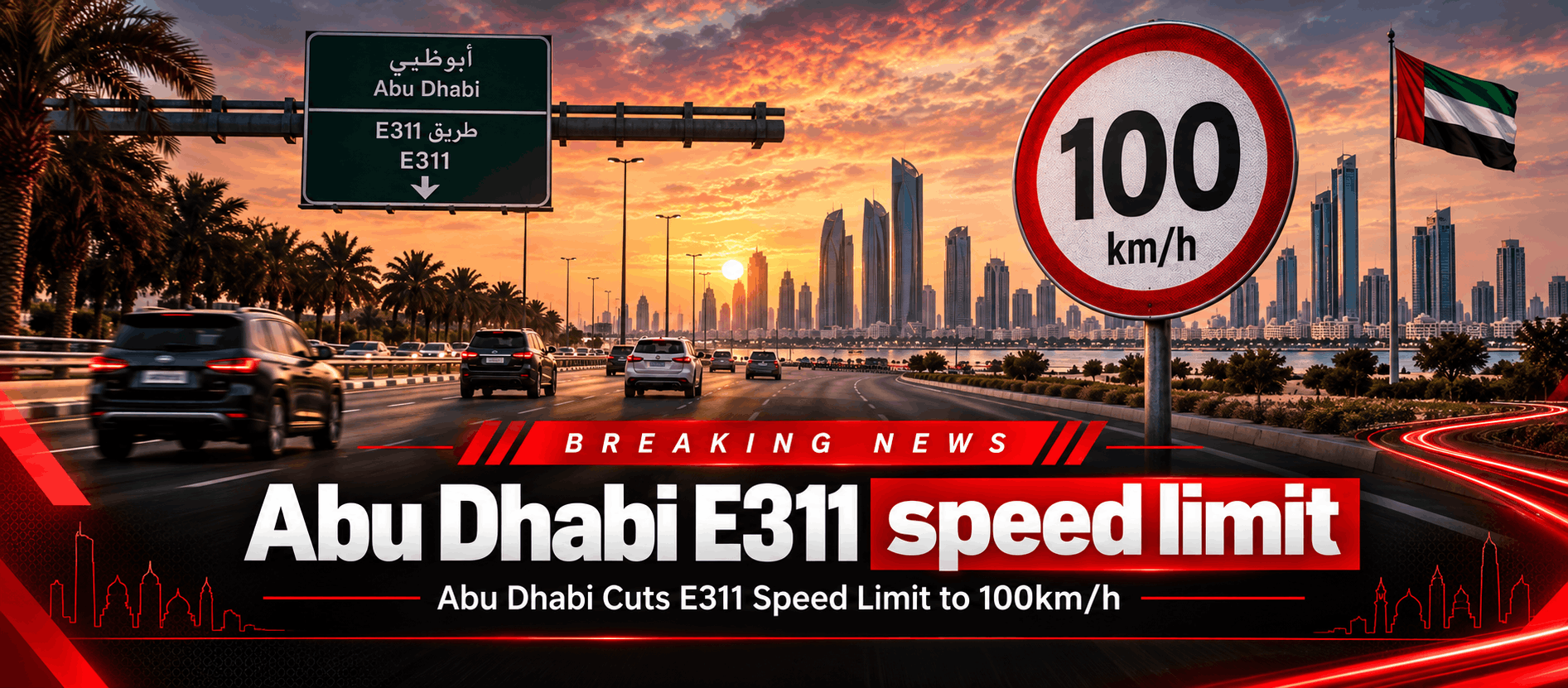
News summary: The maximum speed limit on part of Sheikh Mohammed bin Rashid Al Maktoum Road, or E311, has been reduced from 120km/h to 100km/h. The change took effect on 14 September 2026 and applies to motorists travelling in both directions.
Motorists using a major section of Abu Dhabi’s E311 must now observe a lower maximum speed limit following a road-safety update introduced by Abu Dhabi Mobility.
The speed limit has been reduced from 120km/h to 100km/h on part of Sheikh Mohammed bin Rashid Al Maktoum Road. The new restriction came into effect on Monday, 14 September 2026, and applies in both directions.
Which section of E311 is affected?
The revised speed limit applies between the At Turoush Street–Tawi Al Qaymah Street junctions and the Al Khayr Street interchange.
The affected corridor passes between Al Shamkhah and Madinat Al Riyad, with Baniyas Cemetery serving as a visible landmark near the route. It covers traffic moving towards both Abu Dhabi and Dubai.
Drivers should check the displayed road signs rather than assuming that the entire E311 carries the same speed limit.
The road is officially called Sheikh Mohammed bin Rashid Al Maktoum Road within Abu Dhabi. Motorists may also recognise the E311 route as Sheikh Mohammed bin Zayed Road in Dubai and other emirates.
What exactly has changed?
The change is this: Maximum allowable speed:
- Old max speed: 120km/h
- New maximum speed 100 km/h
- Slowing down: 20 km/h.
- Direction: Two way
- Date of effect: September 14, 2026
This announcement is limited to the section as specified by Abu Dhabi Mobility. Drivers entering or leaving the affected area will have to look for the signs marking the beginning and end of the 100 km/h limit.
Abu Dhabi does not use a 20km/h speed buffer
The update is particularly important for motorists travelling from Dubai or the Northern Emirates because speed-camera enforcement practices are different in Abu Dhabi.
Abu Dhabi does not apply the commonly understood 20km/h allowance used on many roads in some other emirates. Drivers must therefore treat the posted 100km/h limit as the maximum permitted speed on the affected section.
Motorists should reduce their speed before entering the revised zone instead of braking suddenly after seeing a radar or speed-limit sign.
How will the change affect journey times?
The lowering of the limit from 120km/h to 100km/h may add a little to the time taken to travel through the affected section. But the real difference will come down to the density of traffic, road conditions and length of journey within the revised zone. Drivers are advised to build in some extra time, especially around peak commute times. Leaving earlier is safer than attempting to recover time by speeding after passing through the restricted section.
Fleet operators, delivery companies, roadside-assistance providers and commercial drivers should also update route instructions where applicable. Drivers who regularly travel between Dubai and Abu Dhabi may be accustomed to different limits along different sections of E311.
Why motorists must pay close attention
A reduction in speed limits may initially lead to inconsistent driving behavior Some motorists may follow the new 100km/h limit while others continue travelling at the former speed.
Drivers may reduce risk by:
- Searching for changes in speed-limit signs
- Keeping a safe distance behind vehicles
- Not stopping abruptly near enforcement cameras.
- Early move into the right lane
- Let the quick vehicles go safely past
- Avoid using your phone while driving
- Speed adjustment according to traffic and weather conditions
Cruise control or a vehicle’s speed-warning feature can help motorists stay within the revised limit, but drivers are still responsible for watching out for signs and adjusting to changing conditions on the road.
Part of wider speed-management changes
Abu Dhabi has introduced several speed-limit revisions across major roads during 2026.
In February, limits were reduced on sections of the Abu Dhabi–Al Ain Road, or E22. The speed was lowered from 160km/h to 140km/h on one section and from 140km/h to 120km/h on another. Al Rawdah Road, or E30, was also reduced from 120km/h to 100km/h.
The latest E311 update continues the emirate’s broader approach of reviewing speed limits according to road and traffic conditions.
For motorists, the immediate message is straightforward: the maximum speed on the designated E311 section is now 100km/h in both directions, and drivers should rely on current road signs throughout their journey.
SOURCES
- The National — Abu Dhabi cuts E311 speed limit — new limit, effective date, affected section and enforcement guidance.
- Khaleej Times — E311 speed-limit reduction — route boundaries, nearby areas and direction of travel.
- Gulf News — E311 limit reduced to 100km/h — confirmation of the revised limit and official safety advice.