
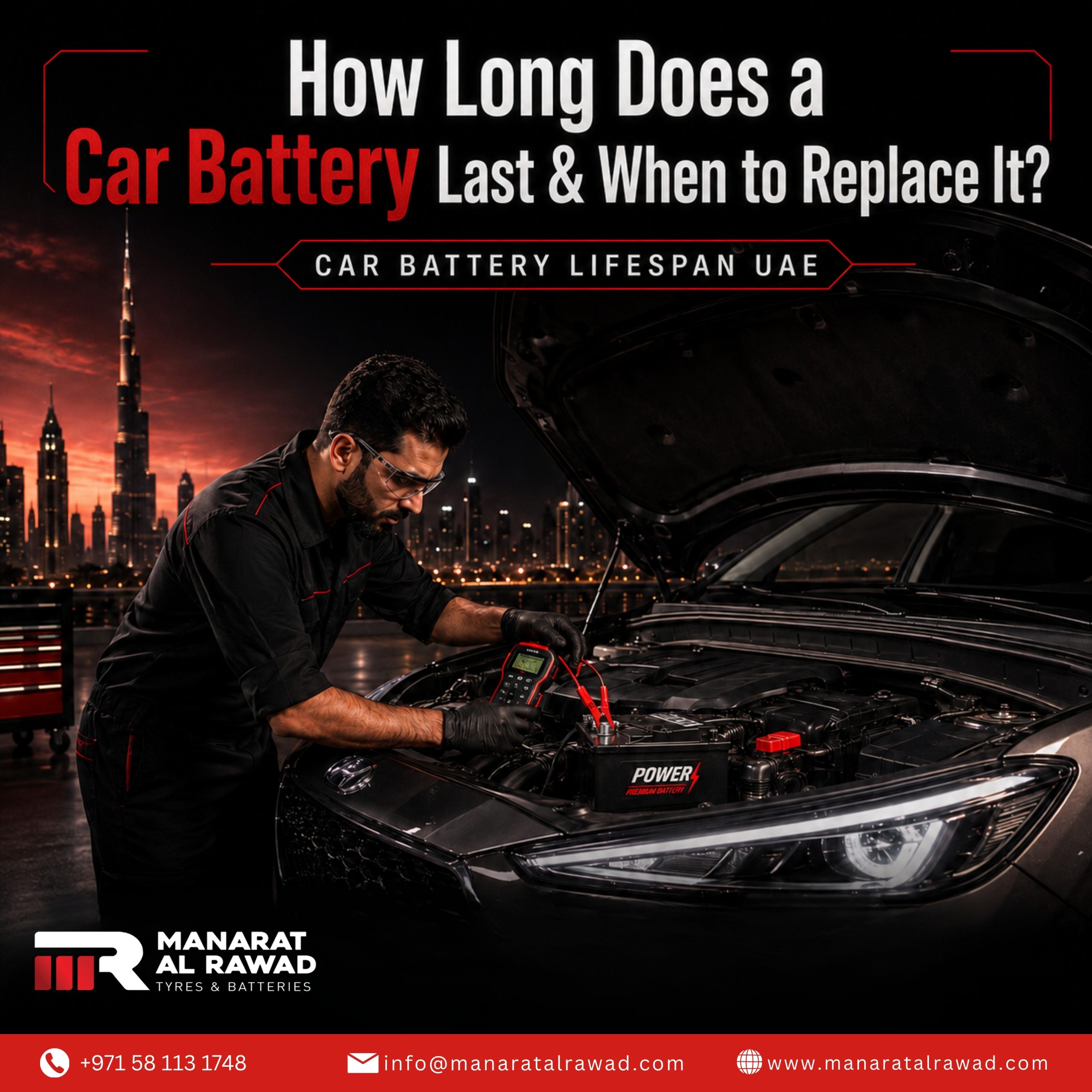
A car battery does not need to be replaced simply because it reaches a certain age. Most conventional car batteries last around three to five years under moderate conditions, but UAE heat can shorten that considerably, often making roughly two to three years a more realistic expectation. Heat accelerates internal battery deterioration, while driving habits, charging-system condition, vehicle electronics, battery type, and maintenance also affect service life.
For UAE drivers, the practical approach is to monitor the battery’s condition rather than wait for complete failure. Slow starting, repeated jump-starts, dim lights, electrical problems, corrosion, swelling, and poor battery-test results can all indicate that replacement should be considered.
How Much Should a Car Battery Cost to Replace?
In the UAE, a typical car battery replacement can cost between AED 250 and AED 900, although basic batteries can cost less, and premium AGM batteries for luxury or start-stop vehicles can exceed AED 1,000.
The final cost depends primarily on:
- Battery capacity and physical size
- Standard flooded, EFB, or AGM technology
- Vehicle make and model
- Brand and warranty
- Start-stop capability
- Mobile installation or workshop service
- Whether battery registration or coding is required
Current 2026 UAE market guides commonly place conventional batteries for many passenger cars in the lower to middle part of this range, while AGM batteries for vehicles with start-stop systems can reach approximately AED 600–1,200 or more, depending on specification.
A cheaper battery is not automatically a better deal. The replacement should have the correct capacity, terminal orientation, dimensions, cold cranking capability, battery technology, and manufacturer-required specifications. Installing a standard flooded battery in a vehicle designed for AGM or EFB technology can cause poor performance and premature failure.
How Often Should You Replace a Car Battery?
A car battery should usually be replaced when testing shows that it can no longer reliably hold charge or provide sufficient starting power—not simply according to a fixed calendar schedule. In moderate climates, three to five years is commonly quoted as the general lifespan. While In hot climates, battery deterioration happens faster because heat accelerates chemical reactions and internal corrosion.
In the UAE, once a conventional starter battery approaches approximately two years of service, periodic battery testing becomes increasingly useful, particularly before or during the hottest months. A battery may need earlier replacement if:
- The engine regularly cranks slowly.
- The vehicle needs repeated jump-starts.
- Battery testing shows poor capacity.
- It struggles to hold a charge.
- The battery case is swollen or damaged.
- There is excessive corrosion.
- Starting performance becomes inconsistent.
On the other hand, a healthy battery should not be discarded automatically just because it has reached a particular age.
How Long Should a Car Battery Lifespan UAE?
A car battery in UAE conditions commonly lasts around two to three years, although some batteries last longer and others fail sooner depending on the vehicle, battery technology, parking conditions, driving pattern, and charging system.
AAA notes that batteries that can last three to five years overall may have a shorter lifespan in hot climates because high temperatures speed up degradation. Extreme heat can reduce battery life toward roughly two to three years in harsher conditions. This is especially relevant in the UAE, where vehicles are frequently exposed to high ambient temperatures and additional under-bonnet heat. Battery life may be improved by:
- Keeping the battery securely mounted
- Avoiding unnecessary electrical loads when the engine is off
- Taking sufficient-length drives so the charging system can replenish the battery
- Checking for charging-system faults
- Keeping terminals clean
- Testing an aging battery periodically
- Parking in shaded or covered areas where practical
Even a premium battery can fail prematurely if the alternator is faulty or there is a persistent parasitic electrical drain.
What Is the Average Lifespan of a Car Battery?
The commonly quoted average lifespan for a conventional automotive battery is approximately three to five years, but climate has a major influence on the actual result.
AAA identifies time, heat, and vibration as three important factors influencing battery life. Frequent short trips, prolonged periods without driving, and charging-system problems can shorten it further. Therefore, the global three-to-five-year guideline should not automatically be treated as the expected lifespan for every UAE vehicle. A two-and-a-half-year-old battery that tests healthy may still have useful service remaining. A one-year-old battery that repeatedly loses charge needs to be diagnosed, even though it is relatively new.
What Are the Signs of a Dying Car Battery?
Common signs of a weak or dying car battery include slow cranking, difficulty starting, clicking noises, dim or flashing lights, repeated jump-starts, electrical problems, warning lights, corrosion, and physical damage to the battery.
AAA identifies several common warning signs, including slow engine cranking, dim headlights, electrical issues, clicking or unusual starting sounds, dashboard warning lights, corrosion, cracks, and battery-case swelling.
Slow engine cranking
If the starter motor turns the engine more slowly than normal, the battery may no longer be providing sufficient starting current.
Clicking when you try to start
Repeated clicking can occur when there is insufficient electrical power to operate the starter properly. However, poor connections or starter problems can produce similar symptoms.
Dim or flashing lights
Weak electrical performance may indicate insufficient battery voltage, although alternator problems can also affect lighting.
Frequent jump-starts
If the battery repeatedly needs a boost, it should be tested rather than continuously jump-started.
Visible corrosion
Heavy corrosion around the battery terminals can interfere with electrical connections.
Swollen battery case
A swollen or distorted battery should be treated seriously. Excessive heat and internal damage may cause the casing to deform.
Do Car Batteries Give Warning Before Dying?
Sometimes they do, but not always. A battery may show symptoms for days or weeks before failure, while another battery can appear to work normally and then suddenly be unable to start the vehicle.
Possible advance warnings include:
- Slower-than-normal starting
- Intermittent starting difficulty
- Dim lights
- Clicking when starting
- Electrical accessories behaving unusually
- Needing occasional jump-starts
- Battery or charging-system warnings
- A poor battery-test result
This is why preventative testing can be more reliable than waiting for obvious symptoms. A battery can still start the vehicle today, even with little reserve capacity remaining.
How Do I Know If My Battery Needs Replacing?
The most reliable way to determine whether a car battery needs replacement is to combine its age and symptoms with a proper battery and charging system test. Do not rely on age alone. For example, if the battery is relatively new but keeps becoming discharged, replacing it immediately may not solve the problem. The vehicle could have:
- A faulty alternator
- A parasitic electrical drain
- Poor terminal connections
- Corroded cables
- An unsuitable battery specification
- Excessive accessory loads
- A charging-system problem
If testing confirms that the battery has significantly deteriorated and cannot dependably supply the required starting power, replacement becomes the practical solution.
How to Check Car Battery Life
A car battery’s remaining life cannot be determined accurately from voltage alone. Battery age, resting voltage, starting performance, charging voltage, and a proper conductance or load test should be considered together.
A simple visual check can identify obvious problems such as corrosion, loose terminals, damaged cables, leakage, or swelling. A digital multimeter can also provide useful information about battery voltage, but it does not tell the complete story. A battery may show a reasonable voltage but lack sufficient capacity to start the engine reliably. For a more meaningful assessment, a technician can test:
- Battery condition
- Available starting capacity
- Charging-system performance
- Alternator output
- Terminal and cable condition
If the battery repeatedly becomes discharged despite testing healthy, the vehicle may require more electrical diagnosis.
What Kills Car Batteries Quickly?
Extreme heat, repeated deep discharges, short trips, long periods without driving, electrical drains, poor connections, excessive vibration, and charging-system faults can all shorten a car battery’s life.
Extreme heat
Heat accelerates battery deterioration and internal corrosion. This is particularly important in the UAE.
Leaving electrical equipment running
Headlights, interior lights, infotainment systems, chargers, or other accessories can discharge the battery when the engine is off.
Frequent short trips
If journeys are repeatedly very short, the alternator may not have enough time to replace the energy used during starting.
Leaving the vehicle unused
A parked vehicle still has small electrical loads from alarms, computers, keyless-entry systems, and other electronics. Over time, these can discharge the battery.
Alternator problems
Both undercharging and overcharging can shorten battery life.
Loose battery mounting
Excessive vibration can damage internal battery components.
Parasitic electrical drain
An abnormal electrical load that remains active after the vehicle is switched off can repeatedly flatten the battery.
What Shortens Car Battery Life?
The factors that shorten battery life are largely the same ones that cause premature battery failure: heat, undercharging, overcharging, deep discharge, vibration, frequent short-distance driving, electrical drains, and poor maintenance. AAA specifically identifies heat, driving styles, vibration, and charging-system problems among important contributors to shortened battery service life. For UAE drivers, temperature deserves particular attention because it can accelerate deterioration even when the vehicle appears to be operating normally.
Can a Dead Car Battery Be Revived?
A discharged battery can sometimes be recharged and returned to service, but a genuinely failed or damaged battery generally cannot be reliably restored. There is an important difference between discharged and failed. A discharged battery may still be healthy. For example, leaving the headlights on overnight can drain a perfectly serviceable battery. Once it is safely recharged and tested, it may continue working normally.
A failed battery may have:
- Significant internal deterioration
- Damaged plates
- An internal short
- Inability to retain charge
- Severe sulfating
- Physical swelling or leakage
Repeatedly charging or boosting a failing battery does not repair the underlying damage. Testing should determine whether charging or replacement is the more sensible option.
Can I Jump-Start a Completely Dead Battery?
A heavily discharged 12V battery can sometimes be jump-started, but it depends on why it is dead and whether the battery is physically safe. If the battery simply lost charge because lights were left on, a jump-start may get the engine running. However, you should not attempt to jump-start a battery that is:
- Swollen
- Cracked
- Leaking
- Severely corroded or damaged
- Producing unusual smells
- Showing obvious signs of overheating
A completely failed battery may also refuse to accept sufficient charge even after the engine starts. After a successful jump-start, do not automatically assume the problem has been solved. If the battery dies again, have the battery and charging system tested.
What Is the Correct Sequence for Replacing a Car Battery?
For many conventional 12V vehicles, the basic removal sequence is to remove the negative terminal first, then the positive. During installation, connect positive first, then negative.
A general process is:
- Switch off the ignition and all electrical accessories.
- Keep the key or remote away from the vehicle where appropriate.
- Identify the positive (+) and negative (-) terminals.
- Disconnect the negative terminal first.
- Disconnect the positive terminal second.
- Remove the battery retaining clamp or bracket.
- Carefully remove the old battery.
- Install the correct replacement battery.
- Secure the battery firmly.
- Connect the positive terminal first.
- Connect the negative terminal last.
- Verify that both connections are firm.
However, this is general guidance instead of a universal procedure. Modern vehicles can have battery-monitoring systems, backup power requirements, security systems, and manufacturer-specific procedures. Some vehicles also require battery registration or coding after replacement. Always check the owner’s manual or manufacturer procedure for the specific vehicle.
What Not to Do When Replacing a Car Battery
Do not reverse the battery polarity, install the wrong battery specification, create a short circuit across the terminals, or ignore vehicle-specific battery procedures. Serious mistakes to avoid include:
- Do not connect positive and negative terminals backward.
- Do not allow a metal tool to bridge the positive terminal and vehicle body.
- Do not smoke or create sparks around a conventional lead-acid battery.
- Do not install a physically incompatible battery.
- Do not substitute a conventional battery for an AGM or EFB unit when the vehicle requires the latter.
- Do not leave the battery unsecured.
- Do not ignore severe corrosion or damaged cables.
- Do not handle a leaking or badly swollen battery casually.
- Do not assume every modern vehicle can simply have its battery disconnected without consequences.
- Do not skip battery registration or coding where the manufacturer requires it.
If you are uncertain about the correct specification or procedure, professional battery replacement is safer than experimenting.
What Should You Do Immediately After Replacing a Car Battery?
After installing a new battery, verify that it is correctly secured and connected, start the vehicle, look for warning lights, and confirm that the charging system is operating properly.
Depending on the vehicle, you may also need to:
- Reset the clock and date.
- Reinitialize automatic windows.
- Restore radio or infotainment settings.
- Relearn certain vehicle functions.
- Enter a security code on older audio systems.
- Register the new battery with the vehicle’s battery-management system.
- Clear battery-related diagnostic codes where appropriate.
Battery registration is particularly important on certain modern vehicles because the charging system adjusts its strategy based on the battery’s age and condition. A professional replacement service should therefore confirm whether the vehicle requires more than simply removing one battery and installing another.
What Is the 80/20 Battery Rule?
The commonly discussed 20–80 battery rule generally refers to lithium-ion batteries, not the conventional 12V lead-acid starter battery used in most petrol and diesel cars. For lithium-ion batteries, including many electric-vehicle traction batteries, the idea is to keep the normal state of charge roughly between 20% and 80% where practical, rather than repeatedly cycling from nearly empty to fully charged. This can reduce long-term cell degradation. This rule should not be directly applied to a conventional lead-acid starter battery.
A normal 12V starter battery is intended to remain well charged. Repeatedly allowing it to become deeply discharged can actually shorten its life. If the question concerns an electric vehicle’s high-voltage lithium-ion battery, follow the manufacturer’s specific charging recommendations because battery chemistry and battery-management strategies differ between vehicles.
Which Car Battery Is Best in the UAE?
The best car battery in the UAE is the one that meets your vehicle manufacturer’s specifications, suits the vehicle’s electrical demands, is appropriate for UAE heat, and comes from a reputable supplier with clear local warranty support. There is no single battery that is best for every car. Common battery types include:
Conventional flooded battery
Suitable for many vehicles without advanced start-stop systems.
EFB battery
Designed for certain vehicles with basic start-stop technology and greater cycling demands.
AGM battery
Often required by modern vehicles with start-stop technology, high electrical loads, advanced electronics, or sophisticated battery-management systems. Brands commonly found in the UAE include Amaron, Varta, Bosch, ACDelco, Exide, Solite, and others. Local 2026 comparisons also emphasize that the correct technology and vehicle fitment matter more than choosing a brand name alone. Before buying, check:
- Battery type
- Ah capacity
- CCA requirement
- Dimensions
- Terminal position
- Vehicle compatibility
- Manufacturing freshness
- Warranty terms
- Local warranty support
What Brand of Car Battery Lasts the Longest?
There is no single car-battery brand that can reliably be declared the longest-lasting for every vehicle in the UAE. Battery type, correct fitment, heat exposure, manufacturing freshness, charging condition, and driving habits can affect lifespan as much as the brand itself.
Amaron, Varta, Bosch, and ACDelco are among the established options frequently compared in the UAE market, but they address different vehicle types and battery requirements. For example, some European start-stop vehicles may require an AGM battery, while many Japanese or Korean vehicles without start-stop systems use a different specification.
Instead of choosing only by brand reputation, compare:
- Correct manufacturer specification
- Battery technology
- Heat tolerance
- Local warranty
- Manufacturing date
- Distributor support
- Replacement availability
A correctly specified fresh battery with a strong local warranty can be a better purchase than an expensive premium battery that is unsuitable for the vehicle.
Should You Replace the Battery or Keep Using It?
Replace the battery when testing confirms that it is deteriorated, cannot hold sufficient charge, or can no longer reliably start the vehicle. Do not replace it unnecessarily if the real problem is the alternator, electrical system, or parasitic drain. A useful decision process is:
Starting problem → battery test → charging-system test → identify the cause → recharge or replace as appropriate.
This avoids repeatedly replacing batteries when another vehicle fault is responsible.
Mobile Car Battery Replacement in the UAE
When a vehicle cannot start because of a suspected battery problem, driving to a workshop may not be possible. A mobile battery service can test the existing battery at the vehicle’s location and determine whether a boost, recharge, or replacement is appropriate.
Manarat Al Rawad provides battery-related roadside assistance to drivers who need help at their location. When replacement is necessary, the important step is to install a battery that meets the vehicle’s specifications rather than simply choosing the cheapest available option. Battery testing is especially useful because a no-start condition does not automatically mean the battery needs replacing. Confirming the condition of both the battery and charging system helps identify the actual cause.
Car battery replacement in the UAE should be based on battery condition, vehicle requirements, and testing rather than age alone. Although conventional batteries often last three to five years in moderate environments, UAE heat can make approximately two to three years a more realistic service-life range for many vehicles. Signs such as slow cranking, repeated jump-starts, dim lights, poor test results, and visible damage should not be ignored. At the same time, a dead battery does not necessarily mean it needs to be replaced—a healthy battery that was simply discharged may be recoverable.
When replacement becomes necessary, choose the correct capacity and battery technology, follow the proper installation sequence, and determine whether the vehicle requires battery registration or electronic resetting afterward. For battery-related breakdowns that prevent the vehicle from being driven, mobile testing and car battery replacement in the UAE can provide a practical way to diagnose and resolve the issue at the vehicle’s location.