
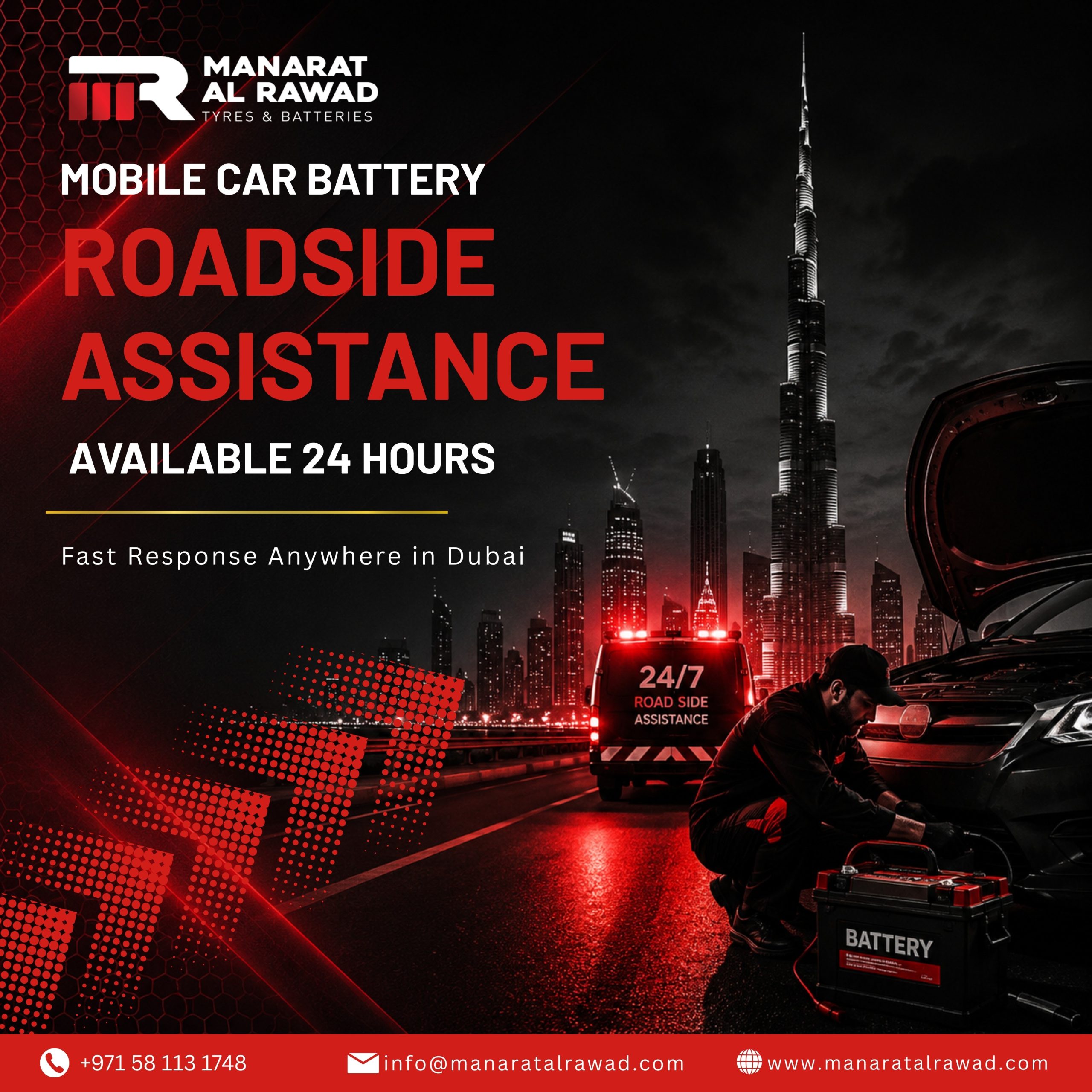
Roadside assistance is an emergency support service for drivers whose vehicles become disabled or cannot continue a journey safely. Depending on the provider and plan, assistance can include battery jump-starts, towing, vehicle recovery, flat-tire help, emergency fuel delivery, lockout assistance, and other breakdown support.
For drivers in the UAE, roadside assistance can be particularly useful when a car will not start at home, in a parking area, at work, or while traveling. However, the exact services, charges, response conditions, and usage limits depend. On your insurance policy, bank card benefit, vehicle warranty, membership plan, or roadside service provider.
What Does Roadside Assistance Mean?
Roadside assistance means getting expert assistance when your vehicle develops a problem that prevents you from continuing your journey normally or safely.
Instead of trying to diagnose or repair the problem yourself, you contact an assistance provider and explain what has happened. Depending on the issue, a technician or recovery vehicle may be sent to your location.
For example, if you turn the key or press the start button and the engine does not start because the battery is low on charge, roadside assistance may provide a battery boost or jump-start. If testing indicates that the battery has reached the end of its service life, mobile battery replacement may be a more practical solution.
Roadside assistance can also help when a vehicle cannot be repaired at its current location. In that situation, recovery or towing may be arranged to transport the car to an appropriate workshop.
It is important to understand that roadside assistance is not necessarily the same as full vehicle repair. Its primary purpose is usually to either get the vehicle moving again or help move it somewhere it can be repaired safely.
What Services Are Usually Included in Roadside Assistance?
The exact package varies, but common roadside assistance services include:
- Battery jump-start or battery boost when the battery lacks sufficient charge to start the engine.
- Vehicle towing or recovery when the car cannot be driven.
- Flat-tire assistance where permitted and when a suitable spare tire is available.
- Emergency fuel delivery if the vehicle runs out of fuel.
- Lockout assistance when keys are locked inside the vehicle, varies by provider.
- Minor roadside support when a simple problem can be safely resolved on-site.
- استبدال بطارية الهاتف المحمول by providers specializing in vehicle battery services.
Coverage should always be checked before requesting assistance, as not every provider offers every service.
What Is the Most Common Roadside Assistance?
There is no single roadside assistance service that is universally the most common, but battery problems, towing or recovery. And flat-tire assistance are among the situations drivers frequently need help with.
Battery-related starting problems are particularly straightforward examples of when roadside assistance can help. A discharged battery may only require a boost, while an old or deteriorated battery may fail again shortly after being jump-started.
That is why proper اختبار البطارية can be valuable. A technician can check whether the problem is simply a discharged battery or whether the battery is struggling to hold sufficient charge.
Not every no-start situation is caused by the battery. Problems involving the starter motor, alternator, electrical connections, terminals, immobilizer, or other vehicle systems can produce similar symptoms. If a jump-start does not solve the problem, further diagnosis or vehicle recovery may be necessary.
How Can I Get Free Roadside Assistance With My Emirates NBD Credit Card?
If you hold an eligible Emirates NBD credit card, you may have access to complimentary 24/7 roadside assistance in the UAE, but eligibility, annual usage limits, and spending requirements depend on your card.
Emirates NBD currently states that its roadside assistance benefit can include vehicle recovery, towing, fuel delivery, and battery boost. Eligible cards have specific yearly usage allowances. Many listed cards receive up to three uses per calendar year, while the Duo Credit Cards and Diners Club Credit Card currently receive two.
To request the benefit, Emirates NBD currently instructs eligible cardholders to call +971 4 387 6628 for 24/7 roadside assistance.
There is also an important spending condition. Emirates NBD states that cardholders using the benefit must maintain a minimum monthly spend of AED 5,000 in the month the benefit is used. If the required spend is not achieved, an AED 99 fee can apply for using the service.
The bank also states that towing is generally to the nearest workshop within the emirate and that the roadside service can be used only once within a 24-hour period by either the primary or supplementary cardholder.
Because card benefits and terms can change, check your specific Emirates NBD card’s current benefits before relying on the service.
Do We Need to Pay for Roadside Assistance?
Sometimes yes and sometimes no. Roadside assistance may be complimentary, included in another product, provided under a limited membership benefit, or charged each time you use it.
For example, roadside assistance might already be included with a qualifying credit card, motor insurance policy, new-vehicle warranty, manufacturer service package, or paid annual membership.
A service described as “free” can still have conditions. There may be annual usage limits, location restrictions, maximum towing distances, eligibility requirements, or minimum-spend conditions.
The Emirates NBD example demonstrates why checking the terms matters. Eligible cardholders can receive complimentary assistance within their allowance, but the bank currently requires AED 5,000 of monthly spending. During the month the benefit is used; otherwise, an AED 99 charge may apply.
If you do not have roadside assistance included with another product, you can usually contact a service provider directly. And pay for the required service before confirming a callout, ask what the price includes. And whether extra charges can apply for towing distance, specialized recovery, parts, replacement batteries, or services outside standard coverage.
Who Has the Best Roadside Assistance?
There is no single roadside assistance company that can objectively be called the best for every driver. The right provider depends on the type of breakdown, required coverage, location, response availability, and included services.
A useful roadside assistance provider should clearly explain what it can do before dispatching help. For a complete breakdown plan, consider whether the provider offers towing, recovery, battery assistance, tire support, fuel delivery, and other emergency services that matter to you.
You should also check geographical coverage. A service that works well for someone driving mainly within one emirate may not provide the same value to someone who regularly travels across the UAE.
For battery-specific problems, a specialist mobile battery service may be more appropriate than a general towing service. For example, when a car will not start due to a suspected battery issue, Manarat Al Rawad can be considered for battery testing, jump-start assistance, and mobile battery replacement, where applicable.
The key is to match the service provider to the actual problem rather than choosing solely because a company employs terms such as “best” or “fastest.”
What Is the Best Car Breakdown Service?
The best car breakdown service is one that covers the problems you are likely to face, operates where you drive, explains its charges clearly, and provides the appropriate type of assistance.
For a vehicle that has completely broken down because of a mechanical fault, towing or recovery capability may be the most important factor. For a car with a flat tire, tire assistance could be enough. A battery-related starting issue, sending a battery technician may be more useful than immediately sending a tow truck. The technician can inspect the battery condition, attempt a safe boost when appropriate, and determine whether replacement is necessary.
A suitable breakdown service should also avoid unnecessary part replacements. For example, a vehicle that does not start does not automatically need a new battery. A discharged but otherwise healthy battery may be recoverable, while an aged battery that repeatedly loses charge may require replacement.
If the battery repeatedly becomes discharged even after replacement or recharging, the charging system or another electrical issue should be investigated.
How Do You Use Roadside Assistance?
To use roadside assistance, first make yourself and the vehicle as safe as reasonably possible. Then contact your provider and give them your location, vehicle details, and a clear description of the problem.
A typical process is simple:
- Move the vehicle to a safe location if it can be moved safely.
- Use hazard lights where appropriate.
- Contact the roadside assistance number, app, insurer, bank card assistance service, or your chosen provider.
- Provide your accurate location or a nearby landmark.
- Give your vehicle make, model, registration details, and other information requested by the provider.
- Explain what happened—for example, “the engine will not crank,” “the battery seems dead,” “I have a flat tire,” or “the vehicle cannot be driven.”
- Confirm whether the requested service is covered and whether a charge will apply.
- Follow the provider’s safety instructions while assistance is being dispatched.
Giving specific symptoms helps the provider send the appropriate type of assistance.
For example, saying only “my car is broken” gives limited information. Saying “the dashboard lights come on, but the engine will not crank, and I hear clicking when I try to start it” gives the technician a better indication that the starting or battery system should be checked.
Should You Request a Jump-Start or Battery Replacement?
A jump-start is appropriate when the battery is simply discharged and still holds a charge. Replacement is more appropriate when testing shows the battery has deteriorated or can no longer provide reliable starting power.
A battery can lose charge because lights or accessories were left running. The vehicle remained unused for an extended period, or another electrical problem drained it. In these situations, a boost may get the vehicle running again.
However, repeated starting problems, slow engine cranking, declining battery performance, or a battery that quickly loses charge again can indicate that further testing is required.
Do not assume that repeatedly jump-starting the car solves the underlying problem. If the battery itself is healthy but continues to discharge, the charging system or another source of electrical drain may need to be investigated.
For drivers who cannot start their vehicle, a mobile service such as Manarat Al Rawad can provide battery-related roadside assistance, including testing and replacement when a new battery is needed.
Roadside Assistance or Towing: Which Do You Need?
Roadside assistance should normally be considered first when the problem can potentially be resolved where the vehicle is located. Towing is more appropriate when the vehicle cannot be safely or practically returned to service at the roadside.
A weak or discharged battery, or minor roadside problems, may be resolved without moving the vehicle.
Towing is more likely to be necessary when there is a significant mechanical failure, accident damage, an unresolved electrical fault, overheating, or another condition that makes driving unsafe. The assistance provider should be told as much as possible about the symptoms. So it can determine whether to send a mobile technician, recovery vehicle, or tow truck.
Conclusion
Roadside assistance provides practical help when a vehicle cannot continue its journey. Due to a battery issue, a breakdown, a flat tire, lack of fuel, or another covered problem. Depending on the provider, assistance may involve fixing a simple issue at the vehicle’s location or recovering the vehicle to a workshop.
Roadside assistance is not always an additional paid service. It may already be available through your credit card, insurance policy, vehicle warranty, or membership plan. Emirates NBD, for example, currently provides complimentary roadside assistance on eligible credit cards subject to card-specific usage allowances and conditions.
For battery-related breakdowns, the most useful first step is often to determine whether the battery simply needs a boost or whether testing confirms that replacement is necessary. Choosing assistance based on the actual problem can avoid unnecessary towing, repeated jump-starts, and unnecessary replacement.