
News Analysis
- News value: Honda has developed an in-road wireless charging system and plans to test it on a Japanese highway.
- Key angle: The technology could reduce charging stops for electric trucks, but infrastructure costs and commercial viability remain unresolved.
- UAE relevance: Dubai has previously tested dynamic road charging and continues to invest in electric mobility infrastructure.
- Target audience: UAE EV owners, fleet operators, logistics companies, and automotive technology readers.
- Focused keyword: dynamic wireless EV charging
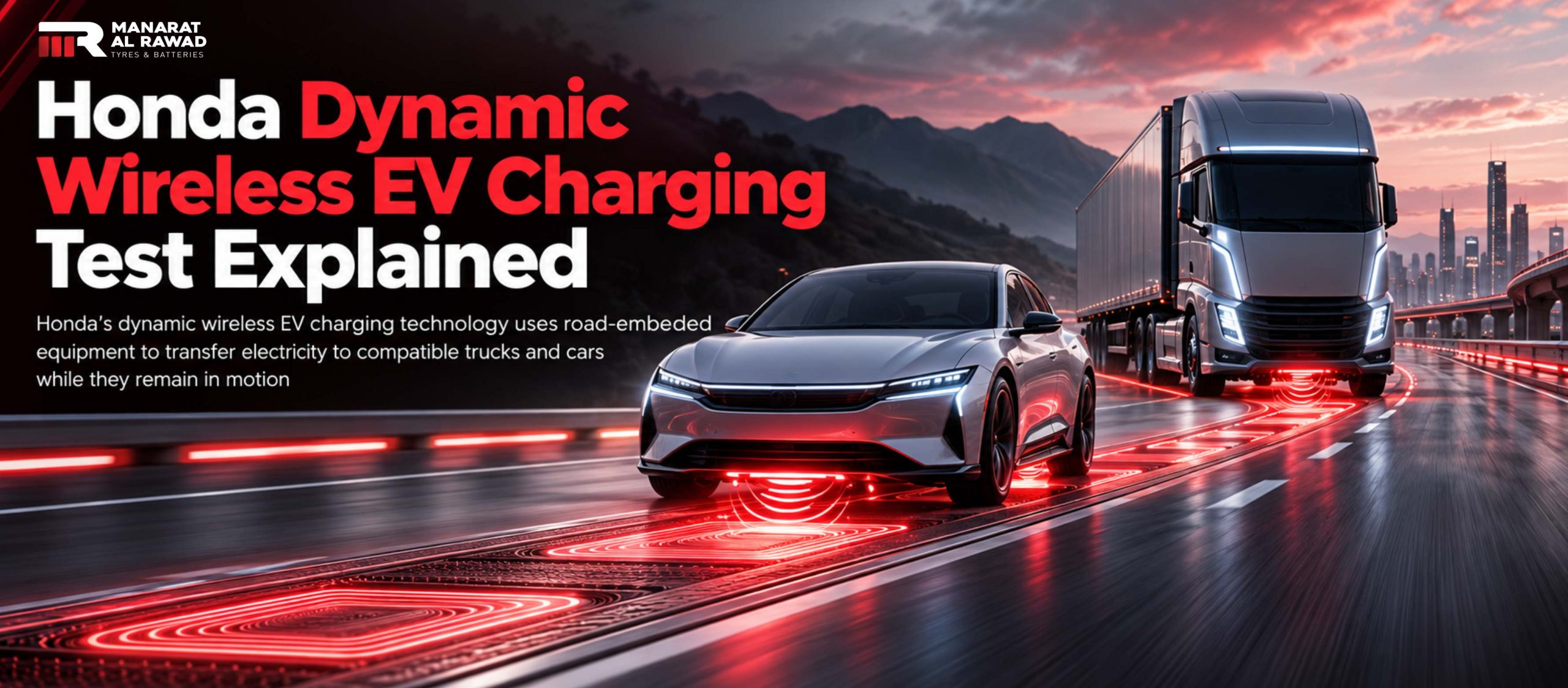
Japanese automaker Honda is preparing to move electric vehicle charging from roadside stations into the road itself.
The company has developed technology that can transfer electricity wirelessly from equipment embedded beneath a road to compatible electric vehicles traveling above it. Honda says the system could support passenger vehicles and large electric trucks, likely reducing the time commercial fleets spend parked at charging stations.
Honda plans to conduct a real-world highway test in Japan with construction company Taisei and road specialist Taisei Rotec during the financial year beginning in April 2027 or later. Honda’s research division developed the technology in cooperation with the two companies.
What Is Dynamic Wireless EV Charging?
Dynamic wireless EV charging allows an electric vehicle to receive energy while it is moving.
Charging equipment installed beneath the road creates an electromagnetic field. A receiver fitted to the underside of a compatible vehicle captures that energy and converts it into electricity, which can then power the vehicle or recharge its high-voltage traction battery.
It uses the same broad principle as wireless phone charging, but on a substantially larger scale and under more demanding operating conditions.
Unlike conventional charging, the driver does not have to connect a cable or remain parked beside a charger. However, both the road and vehicle require specially designed hardware.
What Has Honda Announced?
| تفاصيل | Current information |
| Technology | Wireless power transfer from charging units embedded in roads |
| Intended vehicles | Electric cars and large electric trucks |
| Development partners | Honda R&D, Taisei and Taisei Rotec |
| Planned test location | A highway in Japan |
| Expected timing | Financial year beginning April 2027 or later |
| التوفر التجاري | Not announced |
| Estimated cost | Still being assessed |
Honda’s immediate objective is to verify whether the system can operate reliably under real highway conditions. According to Reuters, the company has not supplied a cost comparison with conventional fast-charging networks because it still needs to evaluate economic viability.
Why Could Electric Trucks Benefit Most?
Long-distance electric trucks carry large batteries because they need substantial driving range while hauling heavy loads. Those batteries add weight, take up space, and may require lengthy high-power charging stops.
Dynamic charging lanes could potentially supply electricity during part of a truck’s journey. This may provide several benefits:
- Fewer or shorter charging stops
- More predictable fleet schedules
- Better vehicle utilization
- Reduced pressure on busy charging hubs
- Potential use of smaller batteries on suitable routes
These benefits are possibilities, not confirmed outcomes. They will depend on charging power, road coverage, vehicle efficiency and the cost of installing the infrastructure.
Passenger vehicles may also use the technology, but commercial routes may present the stronger early business case. Trucks and buses frequently travel along fixed corridors, making it easier to concentrate charging equipment where it would be used regularly.
Will Wireless Roads Replace Fast Chargers?
Not in the foreseeable future.
Installing dynamic charging equipment beneath public roads would require major construction, electricity connections, maintenance systems, and agreed technical standards. Equipping every road would be impractical.
A more likely model would combine several charging techniques:
- Home or depot charging for routine use
- Public fast chargers for longer stops
- Opportunity charging at bus stations and logistics facilities
- Dynamic charging on selected high-traffic corridors
The system must also identify authorized vehicles, measure the electricity delivered, and charge the correct customer without interfering with surrounding vehicles or electronic equipment.
What Challenges Must Honda Resolve?
Cost is likely to be the most important issue. Road operators would have to determine whether installing and maintaining wireless charging equipment delivers enough value compared with building conventional charging stations.
Other questions include:
- How competently can electricity be transferred at highway speeds?
- Can the equipment withstand heavy trucks, rain, and repeated road repairs?
- Will systems from different manufacturers be compatible?
- How will drivers or fleet operators be billed?
- Can the electricity network support continuous high-power demand?
- How much energy will a vehicle receive over a short charging session?
Hot climates bring in extra considerations. Any future UAE deployment would need to perform reliably under high road-surface temperatures, dust, sand and heavy air-conditioning demand.
Could Dynamic Wireless Charging Come to the UAE?
Honda has not confirmed any deployment in the UAE. Nevertheless, the underlying concept is not unfamiliar to Dubai.
In 2020, Dubai’s Roads and Transport Authority tested dynamic wireless charging for an electric vehicle and bus along a 60-meter road section in Dubai Silicon Oasis. The trial used a power-charging grid installed beneath the road and magnetic-resonance technology to charge vehicles in motion.
Dubai is also preparing to host EV World 2026 from November 10 to 12. RTA says the event will cover electric vehicles, charging infrastructure, battery management and smart mobility technology, representing the emirate’s wider zero-emission transport strategy.
These projects do not mean wireless highways are imminent. They do, however, show that the UAE could be a relevant testing environment if the technology progresses beyond trials in Japan.
Does Road Charging Eliminate the Conventional Car Battery?
No. Dynamic road charging targets an EV’s high-voltage traction battery, which powers the electric motor.
Most electric vehicles also contain a smaller 12-volt auxiliary battery. It operates systems such as locks, lights, control modules, and safety electronics. An EV may still fail to start if this auxiliary battery weakens, even if its main traction battery is charged.
Consequently, diagnostics and services such as mobile car battery replacement in the UAE will remain relevant as electric vehicles grow more common.
ماذا يحدث بعد ذلك؟
Honda’s highway trial will need to demonstrate more than successful energy transfer. It must provide evidence about durability, charging efficiency, construction requirements, operating costs, and compatibility with real traffic.
If the results are positive, dynamic wireless EV charging could eventually become a useful solution for selected freight, bus, and logistics corridors. Until those results are available, it should be viewed as a hopeful infrastructure experiment—not an immediate replacement for plug-in charging.
الأسئلة الشائعة
Can an electric vehicle really charge while driving?
Yes, provided the vehicle has a compatible receiver and is traveling over a road equipped with dynamic wireless charging hardware.
Can every current EV use Honda’s system?
No. Existing electric vehicles would require compatible receiving equipment and supporting electronics.
When will Honda test the technology?
Honda plans a Japanese highway test during the financial year beginning in April 2027 or later.
Is dynamic wireless EV charging available in the UAE?
No commercial service has been announced. Dubai previously conducted a limited dynamic charging trial in 2020.
Will it replace charging stations?
Probably not. It is more likely to complement home, depot, and public fast charging on selected high-use routes.
Sources
- Reuters — Honda highway wireless-charging test announcement, October 5, 2026.
- Government of Dubai Media Office — RTA dynamic vehicle-charging trial.
- Dubai Roads and Transport Authority — EV World 2026 announcement.