
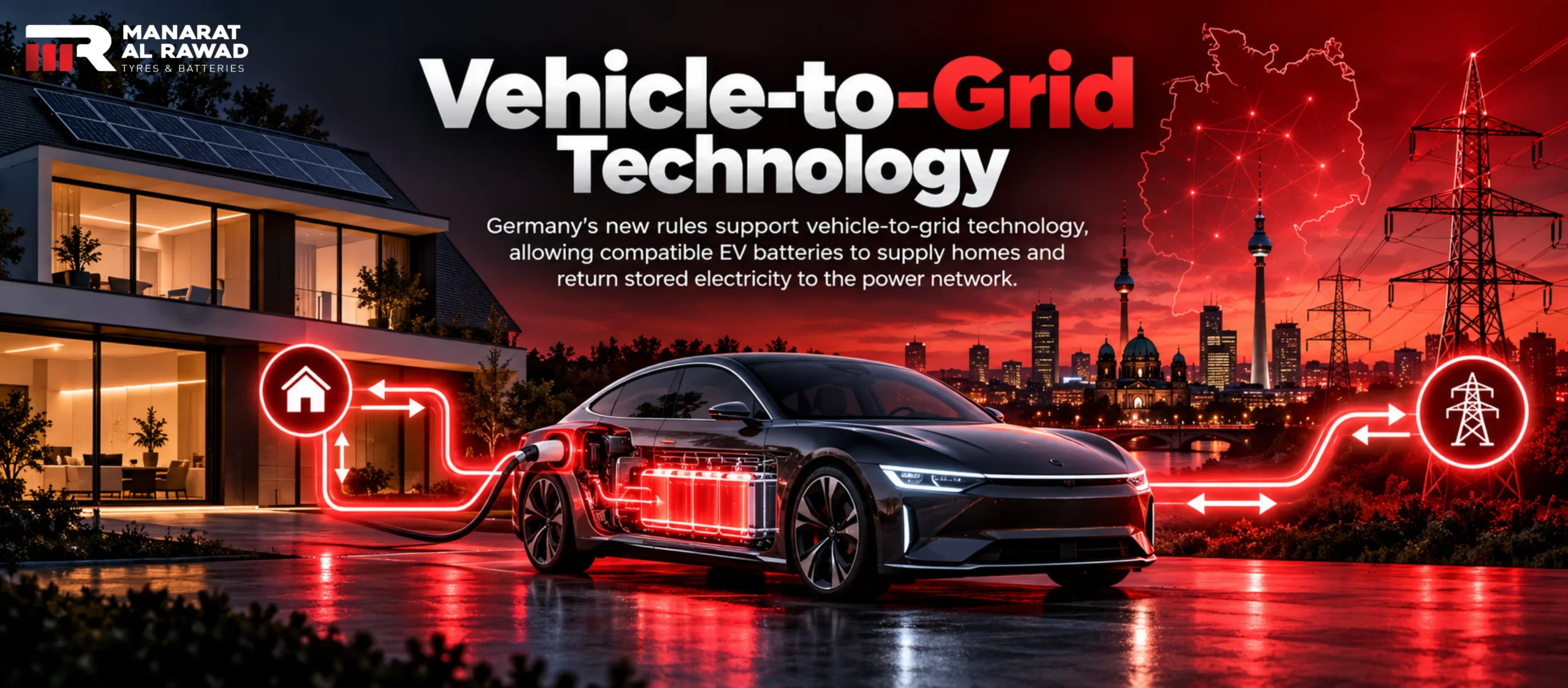
Electric vehicles may soon become more than a form of transport in Germany. New regulations adopted by the country’s Federal Network Agency are intended to make it easier for compatible EV batteries to power buildings and return stored electricity to the national grid.
The framework, known as MiSpeL, addresses regulatory and billing barriers that formerly limited the commercial use of bidirectional charging. It allows eligible charging points to participate in the electricity market in a similar way to stationary energy-storage systems.
The decision does not mean every electric car can immediately power a home. Drivers will still require a compatible vehicle, a bidirectional charger, appropriate metering, an energy-management system and permission to connect the equipment to the local grid.
What is vehicle-to-grid technology?
Vehicle-to-grid technology, commonly shortened to V2G, allows electricity to flow in both directions between an electric vehicle and the power network.
A conventional EV charger only sends electricity from the grid into the vehicle. A bidirectional system can also take stored energy from the vehicle’s traction battery and deliver it elsewhere.
The technology generally includes several related applications:
| Technology | Main function |
| Vehicle-to-Grid | Sends electricity from an EV to the public power grid |
| Vehicle-to-Home | Uses the EV battery to supply a house |
| Vehicle-to-Building | Supports the electricity demand of a commercial building |
| Vehicle-to-Load | Powers compatible appliances or equipment directly |
Vehicle-to-load capability, already offered on several modern EVs and plug-in hybrids, is not the same as powering a whole house or exporting electricity to the grid.
What changed in Germany?
Germany’s Federal Network Agency adopted the MiSpeL framework on 1 October 2026.
The decision creates new methods for recording electricity stored in home batteries and bidirectional EV charging points. This is important when a battery contains electricity from different sources, such as rooftop solar panels and the public grid.
Under the new approach, households can store electricity when renewable generation is high, or market prices are lower. Households can then use the stored power or return it to the grid when demand and prices rise.
The rules are also intended to prevent electricity from being charged twice with certain grid fees and levies when it is temporarily stored and later exported. Eligible renewable electricity can continue receiving applicable support even when mixed storage systems are used.
Germany’s automotive industry described the decision as an important step towards making bidirectional charging commercially viable.
How can an EV battery support a home?
A compatible vehicle can be charged during periods when electricity is plentiful or comparatively inexpensive. Its battery can then supply part of the home’s demand during more expensive peak periods.
For a home with solar panels, the vehicle could store excess daytime solar generation instead of sending all unused electricity directly to the grid. That energy could later power lights, appliances or air conditioning after sunset.
During an electricity interruption, some vehicle-to-home systems may also provide limited backup power. This ability depends on the vehicle, charger, electrical installation, and local safety regulations. A normal charging cable cannot safely perform this function.
The car’s software can maintain a minimum charge level selected by the owner, helping ensure enough energy is left for the next journey.
Can every electric vehicle use Bidirectional Charging?
No. Bidirectional charging requires support from several parts of the system:
- A vehicle designed to discharge through its charging port
- A compatible bidirectional wallbox or charging station
- Power-conversion hardware
- Smart metering and communication systems
- Approved home electrical equipment
- Utility or grid-operator authorization
- Software that manages charging and discharging
- A suitable electricity tariff or export agreement
Some automobiles provide vehicle-to-load functionality but cannot feed a house or public grid. Other models may contain technically capable hardware while waiting for a software update or regulatory approval.
Owners should therefore verify the vehicle’s exact capability rather than relying only on terms such as “bidirectional ready.”
Does vehicle-to-grid use damage the battery?
Every charge and discharge contributes to battery use, but the effect depends on temperature, depth of discharge, charging speed and the control strategy.
A carefully managed system may use relatively shallow charge cycles and maintain minimum and maximum battery limits. However, repeated high-demand discharge or operation in extreme temperatures could increase wear.
Vehicle manufacturers will need to clarify whether battery warranties include V2G use. Drivers should review warranty terms before enrolling in an energy program that repeatedly charges and discharges the traction battery.
Compare potential electricity savings with installation costs and any effect on long-term battery condition.
Why is vehicle-to-grid technology relevant to the UAE?
Dubai’s EV population and charging network are expanding rapidly. DEWA reported 47,944 electric vehicles in the emirate by the end of 2025 and 2,223 charging points by the first quarter of 2026.
In its WETEX 2026 mobility coverage, DEWA identified V2G as an emerging technology that can support load shifting, voltage management, and renewable-energy integration when enough compatible vehicles participate.
The concept could be particularly relevant to the UAE because solar generation is strongest during daylight hours, while residential electricity demand can remain high after sunset. Parked EVs could potentially store part of that daytime energy for later use.
However, DEWA’s published information does not announce a general program allowing Dubai motorists to sell electricity from EV batteries to the grid. Local deployment would require approved chargers, technical standards, metering rules, tariffs and grid-connection procedures.
Dubai already requires public charging operators to obtain a DEWA license and comply with regulations created to protect customers and the electricity network.
Is an EV traction battery the same as a car’s 12-volt battery?
No. Vehicle-to-grid systems use the large high-voltage traction battery that powers the electric motor.
EVs and hybrids normally also contain a smaller 12-volt auxiliary battery. It operates control modules, locks, lights, and the systems required to activate the high-voltage battery.
An EV can have plenty of energy left in its traction battery but still fail to start if its auxiliary battery is discharged. Access to mobile car battery assistance in the UAE therefore continues to be relevant for conventional, hybrid, and electric vehicles, although work on a high-voltage battery must be handled by appropriately qualified specialists.
What needs to happen before V2G becomes common?
Extensive adoption will require cooperation between car manufacturers, electricity providers, charging companies, regulators and property owners.
The most important following steps include:
- More bidirectional-compatible EV models
- Lower-cost home charging equipment
- Standardized connectors and communication standards
- Clear export tariffs and customer incentives
- Battery-warranty protection
- Cybersecurity standards
- Simplified grid approval
- Performance testing in hot climates
Germany’s new framework does not solve every technical or commercial challenge. It does, however, provide an important example of how regulations can allow millions of parked EV batteries to become part of the wider energy system.
الأسئلة الشائعة
Can an electric car power an entire house?
A compatible EV can supply some or all household demand within the system’s power limit. Actual capability depends on the vehicle, charger, home consumption, and battery charge level.
Can any home EV charger send electricity back to the grid?
No. A standard one-way charger cannot export power. A certified bidirectional charger and an approved electrical installation are required.
Is V2G currently available to all UAE EV owners?
No general UAE consumer program has been announced. Availability depends on future regulations, compatible vehicles, and approved grid-connected equipment.
Will the car still have enough energy for driving?
V2G software can reserve a minimum battery level, but the owner must configure the system according to expected travel needs.
Does Germany’s decision apply in the UAE?
No. It applies to Germany, but it provides a regulatory model that other countries may study when developing their own bidirectional-charging policies.
مصادر
- Germany’s Federal Network Agency, MiSpeL decision on integrating storage systems and bidirectional charging points, 1 October 2026.
- Reuters, “German Regulator Clears Path for EV Batteries to Power Homes and Feed Grid,” 1 October 2026.
- German Association of the Automotive Industry, response to the MiSpeL decision.
- DEWA, “WETEX 2026 Features the Present and Prospects of Sustainable Mobility.”
- DEWA, Regulatory Framework for EV Charging Infrastructure in Dubai.